Views: 0 Author: Site Editor Publish Time: 2026-07-27 Origin: Site
Roll material degradation directly correlates with unplanned mill downtime and severe yield loss in high-temperature environments. When surface wear accelerates or thermal fatigue sets in, operators face immediate dimensional tolerance issues on the finished strip. The core engineering challenge lies in balancing extreme wear resistance with thermal fatigue and impact toughness under severe mechanical loads. Choosing the wrong alloy leads to catastrophic roll failure, scrap generation, and compromised plant efficiency.
Implementing a structured framework for rolling mill roll material selection requires evaluating metallurgical properties against position-specific requirements. By understanding failure mode mitigation and matching the right microstructures to specific mill stands, plant operators can drastically increase campaign lengths and maintain tight product tolerances.
Material requirements must be dictated by roll position: work rolls demand high thermal fatigue resistance and hot hardness, while backup rolls require deep hardenability and core toughness.
Advanced alloys like High-Speed Steel (HSS) and High-Chromium cast iron offer superior wear resistance but mandate stringent, upgraded cooling protocols to prevent catastrophic thermal shock.
Matching roll metallurgy to specific mill stages (e.g., roughing vs. finishing stands) is the most effective variable in mitigating premature failure modes like spalling, banding, and fire cracking.
Table of Contents
Hot rolling subjects rolls to severe thermal cycling. As the roll bites the hot strip, surface temperatures spike rapidly. Moments later, water cooling headers quench the surface, creating massive temperature gradients. This continuous thermal shock drives oxidation and initiates microscopic surface cracks. Mechanical stress factors compound these thermal loads. Rolls endure massive rolling loads, high-impact forces at the initial bite, and continuous bending moments across the barrel length. The friction and abrasive wear dynamics between the hot strip and the roll surface physically strip away the roll matrix, demanding materials that can resist both abrasive loss and thermal degradation simultaneously.
To manage these stresses, mill engineers must monitor specific operational parameters. Roll surface temperatures often exceed 600 degrees Celsius in the bite zone before dropping below 100 degrees Celsius under the cooling headers. This rapid fluctuation requires a roll matrix with a highly specific coefficient of thermal expansion. If the shell expands too rapidly compared to the core, internal shear stresses will tear the roll apart from the inside out.
The mechanical properties of the strip dictate the required roll material parameters. Rolling standard carbon steel presents a predictable wear pattern. However, processing Stainless Steel, High-Strength Low-Alloy (HSLA), or Silicon electrical steels completely changes the dynamic. High-alloy strip grades maintain higher deformation resistance at elevated temperatures. This escalates thermal loads and multiplies roll surface shear stresses.
Strip Grade | Deformation Resistance | Primary Roll Stress Factor | Recommended Roll Matrix Attribute |
|---|---|---|---|
Low Carbon Steel | Low to Moderate | Standard abrasive wear | Balanced toughness and hardness |
HSLA | High | Elevated rolling loads, high friction | High compressive yield strength |
Stainless Steel | Very High | Severe thermal transfer, galling | Extreme hot hardness, oxidation resistance |
Silicon Electrical Steel | High | Abrasive scale formation | High primary carbide volume |
Furthermore, the scaling characteristics of different steel grades impact the rate of abrasive wear. Hard, adherent scale acts like a grinding abrasive, rapidly deteriorating the roll surface if the selected roll material lacks sufficient carbide hardness. Operators must match the roll's carbide type (e.g., MC, M7C3) to the specific hardness of the scale generated by the strip.
Operators measure material efficiency using tonnage rolled per campaign. This metric serves as the primary indicator of wear rate. As the roll surface degrades, the surface quality and dimensional tolerance of the finished rolled product decline. A successful roll material extends the campaign length while maintaining a stable profile.
Establish baseline tonnage targets for each specific mill stand based on historical wear data.
Monitor strip profile continuously using inline gauge measurement systems to detect early signs of thermal crown degradation.
Record the exact depth of cut required during each regrinding cycle to calculate the true wear rate per thousand tons rolled.
Analyze the surface finish of the roll post-campaign to identify micro-cracking or banding initiation.
Evaluating the frequency and depth of cut required during regrinding cycles determines the actual lifespan of the roll. Materials that require heavy stock removal to eliminate fatigue cracks ultimately offer shorter operational lives, regardless of their initial wear resistance.
Work rolls require exceptionally high hot hardness and oxidation resistance because they make direct contact with the hot steel strip. The material must resist thermal cracking, commonly known as fire cracking, which occurs due to the aggressive heating and cooling cycles. Surface banding, where oxidized layers peel away, must also be controlled through proper metallurgical selection.
The friction requirements change depending on the stand. Early roughing stands need a high friction coefficient to ensure a strong bite on the thick slab. Conversely, late finishing stands require a smooth, dense surface finish to impart a high-quality texture to the final sheet. Work rolls in the finishing train often utilize complex bi-metallic structures, combining a highly alloyed shell for wear resistance with a nodular iron core to absorb bending stresses.
The backup roll supports the work roll and distributes extreme rolling loads across the mill housing. These rolls require high contact fatigue strength and deep hardenability to resist plastic deformation under massive pressure. Subsurface shear strength is absolutely critical. Without it, heavy cyclic loading initiates subsurface fatigue cracks, leading to massive spalling events where large chunks of the roll barrel break away.
When comparing microstructures, forged backup rolls generally offer superior structural integrity and higher resistance to Hertzian contact stress compared to cast alternatives. The forging process eliminates internal porosity and aligns the grain structure, providing the directional strength necessary to survive years of continuous, heavy-duty operation.
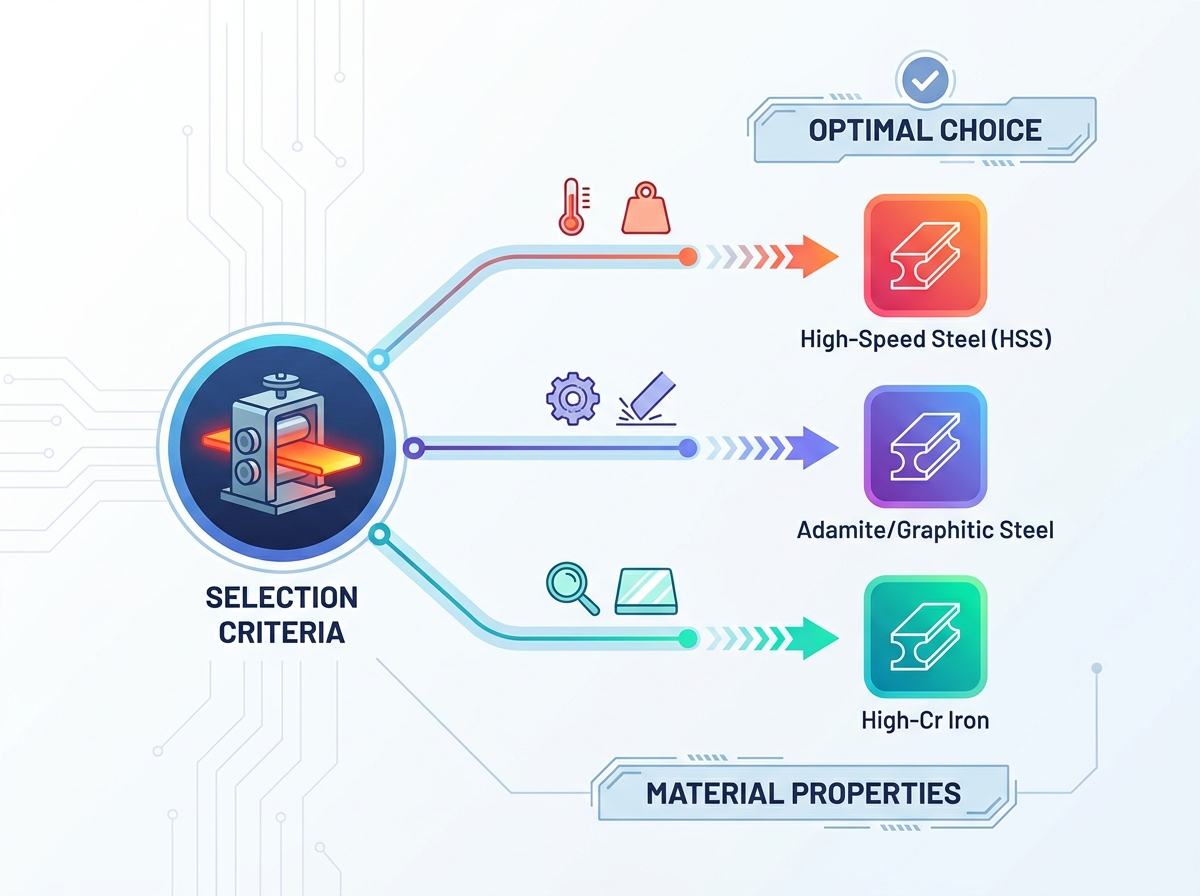
Adamite rolls feature a carbon-rich steel matrix alloyed with nickel, chromium, and molybdenum. These rolls are primarily deployed in roughing stands and intermediate stands where thermal bite and impact resistance take priority over absolute wear resistance. They offer a highly reliable balance of strength and toughness, absorbing heavy impact loads without fracturing.
The main trade-off is their lower wear resistance compared to high-alloy alternatives. Operators using adamite must schedule more frequent roll changes, but they benefit from a highly forgiving material that rarely suffers from catastrophic brittle failure. The microstructure typically consists of pearlite and bainite with a network of primary cementite, providing a rough surface that grips the incoming slab effectively.
High-Chromium materials utilize a 12-22% Chromium matrix that forms hard, wear-resistant eutectic carbides, typically M7C3 type. These rolls dominate early finishing stands in hot strip mills. They deliver excellent wear resistance and maintain a consistent surface finish over long campaigns.
The primary trade-off is their high susceptibility to thermal shock. Operating high-chrome rolls requires precise cooling header alignment and strict temperature management. Any disruption in cooling water flow can cause immediate and deep thermal cracking across the roll barrel. The M7C3 carbides provide excellent resistance to abrasive wear, but the matrix must be carefully tempered to avoid retained austenite, which can transform under pressure and cause dimensional instability.
High-Speed Steel rolls consist of a high carbon matrix heavily alloyed with tungsten, molybdenum, vanadium, and chromium. This chemistry forms extremely hard MC and M2C type carbides. HSS rolls are the premier choice for late finishing stands requiring extended, high-tonnage campaigns. They provide the highest wear resistance and hot hardness available for conventional hot strip mills.
They require specialized grinding wheels, rigorous thermal management, and flawless mill alignment. Poor handling or inadequate cooling will quickly destroy an HSS roll through peeling or severe thermal fatigue. The secondary hardening effect during heat treatment gives HSS its incredible high-temperature stability, allowing it to maintain its profile long after standard alloys would have washed out.
These rolls utilize centrifugally cast or composite structures featuring a highly wear-resistant shell bonded to a ductile, tough core. Tungsten carbide rolls dominate high-speed wire rod mills and specialized finishing blocks. They offer extreme wear resistance, holding their groove profiles for massive tonnages.
The material is inherently brittle under impact. They require specialized handling, precise mounting, and strict operational controls to prevent shattering under abnormal rolling conditions. Mounting these rolls often involves hydraulic expansion sleeves to ensure a perfect interference fit without inducing localized tensile stresses that could crack the carbide ring.
Metallurgy dictates an inverse relationship between wear resistance and impact resistance. Increasing the carbide volume and hardness improves wear life but drastically reduces fracture toughness. Engineering composite and compound rolls solves this paradigm. By utilizing centrifugal casting, manufacturers isolate extreme hardness at the outer shell while maintaining a shock-absorbing, ductile core.
Material Type | Surface Hardness (Shore C) | Impact Toughness | Primary Failure Risk |
|---|---|---|---|
Adamite | 40 - 55 | High | Rapid abrasive wear |
High-Chromium | 65 - 80 | Moderate | Thermal shock cracking |
High-Speed Steel | 75 - 85 | Low | Peeling, banding |
Tungsten Carbide | 85+ | Very Low | Brittle fracture |
Selecting materials with appropriate thermal expansion coefficients and oxidation behaviors manages crack propagation and limits fire cracking. To prevent spalling in backup rolls, operators must specify materials with adequate subsurface yield strength, ensuring fatigue cracks do not initiate below the work-hardened zone.
Banding and peeling in HSS and high-chrome rolls are mitigated by optimizing the secondary hardening characteristics of the alloy. This helps maintain a stable, protective oxide film on the roll surface during operation. If the oxide film grows too thick, it acts as a thermal insulator, causing the underlying matrix to overheat and shear away under rolling pressure.
Non-uniform wear profiles, such as severe edge wear or center wear, occur due to uneven temperature distribution and localized friction. Roll material selection impacts the formation of thermal crowns. Materials with high thermal conductivity dissipate heat rapidly, reducing the severity of the thermal crown.
Metallurgical uniformity across the roll barrel prevents localized surface degradation. A consistent microstructure ensures the roll wears evenly, maintaining tight strip-profile tolerances and reducing the need for aggressive corrective grinding. Centrifugal casting parameters must be strictly controlled to prevent gravity segregation of heavy alloying elements like tungsten during solidification.
Upgrading roll materials requires a parallel upgrade in roll shop capabilities. Machining HSS and Tungsten rolls demands specialized grinding equipment, specifically CBN (Cubic Boron Nitride) or diamond grinding wheels. Standard aluminum oxide wheels cannot penetrate the hard carbides in these advanced alloys, leading to wheel glazing, chatter marks, and metallurgical burns on the roll surface.
Audit existing roll grinding machines for spindle rigidity and vibration dampening capabilities.
Upgrade coolant filtration systems to handle the fine swarf generated by CBN grinding wheels.
Implement automated eddy current or ultrasonic inspection protocols to detect subsurface micro-cracks post-grinding.
Establish strict wheel dressing schedules to maintain optimal cutting geometry and prevent surface burning.
Mill cooling systems must be evaluated. High-alloy rolls possess extreme thermal sensitivity. Operators must ensure cooling water headers, system pressure, and nozzle configurations are fully optimized to provide uniform, high-volume cooling across the entire roll face to prevent catastrophic thermal failure. A blocked nozzle on an HSS roll will cause localized thermal expansion, leading to immediate spalling.
Effective material selection is a highly specific engineering decision that must align metallurgical properties with specific stand positions, product types, and existing mill infrastructure. Moving to advanced alloys requires careful preparation and system auditing.
Audit current roll failure modes and wear profiles to identify the exact limitations of your existing roll materials.
Evaluate your in-house cooling systems and grinding capabilities to ensure they can support high-alloy or HSS materials.
Calculate target campaign lengths based on your production schedule to determine the necessary wear resistance for each mill stand.
Conduct a controlled pilot trial on a single finishing stand to track tonnage-to-wear ratios safely.
Consult with metallurgical engineers to custom-tune alloy chemistries specifically for your mill's unique rolling loads and strip grades.
Successful rolling mill roll material selection requires matching the right metallurgy to each mill stand, operating condition, and production objective. By balancing wear resistance, toughness, thermal stability, and maintenance requirements, manufacturers can extend roll life, improve strip quality, and reduce overall production costs.
About Anhui Huanbowan High Speed Steel Mill Roll
Anhui Huanbowan High Speed Steel Mill Roll is a professional manufacturer specializing in high-performance rolling mill rolls, including High-Speed Steel (HSS) rolls, high-chromium rolls, and other advanced roll solutions for hot strip mills, bar mills, wire rod mills, and section mills. With advanced casting technology, optimized alloy design, precision heat treatment, and strict quality control, the company helps steel producers improve rolling efficiency, extend campaign life, and lower maintenance costs.
Select roll materials according to mill stand position, strip grade, and operating conditions rather than using a single material for every application.
Evaluate wear resistance, toughness, thermal fatigue, and maintenance requirements together when choosing rolling mill rolls.
Ensure your cooling systems, grinding equipment, and maintenance capabilities match the requirements of advanced roll materials.
Work with experienced manufacturers that provide customized metallurgical recommendations and comprehensive technical support.
Before selecting a rolling mill roll material, verify the alloy composition, manufacturing process, thermal performance, wear resistance, and supplier expertise to achieve the best long-term rolling performance and return on investment.
A: The ideal material depends on the mill stand. Roughing stands typically use Adamite or alloy cast steel for impact resistance. Early finishing stands benefit from High-Chromium cast iron, while late finishing stands achieve maximum campaign lengths using High-Speed Steel (HSS) due to its extreme hot hardness and wear resistance.
A: High-Speed Steel offers superior hot hardness and wear resistance due to its complex MC and M2C carbides, allowing for longer campaigns. However, HSS is more sensitive to thermal shock and requires stricter cooling protocols and specialized grinding wheels compared to High-Chromium cast iron.
A: Spalling is caused by subsurface fatigue cracks initiating under heavy cyclic loading and Hertzian contact stress. Selecting forged steel materials with deep hardenability and high subsurface shear strength prevents plastic deformation and stops these fatigue cracks from forming.
A: Adamite provides an excellent balance of strength, impact toughness, and thermal bite. Roughing stands experience massive impact forces and heavy drafts. Adamite absorbs these shocks without fracturing, making it highly reliable despite having lower absolute wear resistance than high-alloy materials.
A: Advanced materials like HSS and High-Chrome are highly susceptible to thermal shock. If a mill has inadequate water pressure, poor nozzle alignment, or insufficient cooling volume, these premium rolls will suffer severe fire cracking or catastrophic peeling. The cooling infrastructure must match the material's thermal sensitivity.
A: Cast rolls allow for complex bi-metallic structures ideal for work rolls. Forged rolls offer superior structural density, higher directional strength, and better resistance to subsurface fatigue, making them the standard choice for heavy-duty backup rolls.