Views: 0 Author: Site Editor Publish Time: 2026-07-27 Origin: Site
Rolling mill consumables carry high financial stakes. A poorly specified High-Speed Steel (HSS) roll often leads to catastrophic mill downtime, premature spalling, and severely compromised product surface quality. Procurement teams frequently submit incomplete or ambiguous quotation requests. Missing operational context forces manufacturers to guess critical details. They assume cooling parameters and guess stand positions. Nomenclature confusion complicates the process further. This results in inaccurate bids, mismatched metallurgical properties, and rapid roll failure. You need a structured framework to solve this problem. Building a comprehensive HSS roll RFQ aligns precise dimensional specs, integrates strict metallurgical requirements, and factors in specific mill environmental conditions. This approach ensures accurate bidding, guarantees technical alignment, and maximizes long-term operational value and performance on the mill floor.
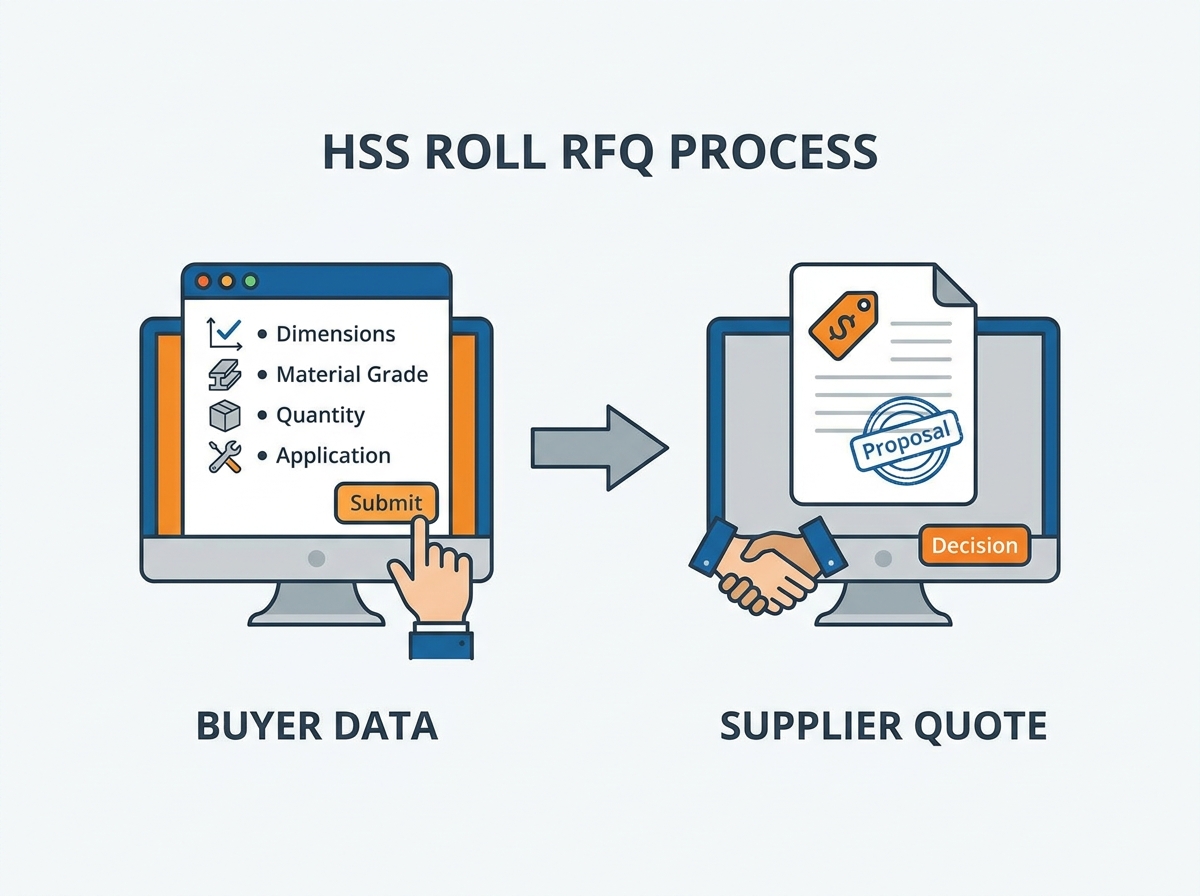
An effective HSS roll RFQ must detail both the physical dimensions and the specific operational environment, including mill stand position and cooling water pressure/volume.
Clearly differentiate HSS roll metallurgy from other industry "HSS" terms—such as Hollow Structural Sections (construction) and high-speed tool steel suffixes (e.g., HSS-Co, HSS-G)—to prevent critical material spec errors.
Define metallurgical requirements—specifically surface hardness, hot hardness, core material, acceptable hardness drop, and microstructural composition—to secure accurate vendor pricing.
Specifying Non-Destructive Testing (NDT) and heat treatment documentation upfront prevents quality disputes and ensures structural stability under high-temperature rolling conditions.
Evaluating RFQ responses requires looking beyond unit price to assess the supplier’s casting methodology, thermal stability guarantees, and historical wear resistance data.
Table of Contents
Successful HSS roll procurement relies on strict performance criteria. You want to maximize tons rolled per millimeter of wear. You must minimize unplanned roll changes. You need excellent strip or bar surface quality. Achieving these goals requires absolute clarity in your request. Vague specifications destroy roll performance. Omitting specific rolling temperatures leads to incorrect carbide matrix selection. Failing to state rolling speeds causes manufacturers to guess. Leaving out the material grades being rolled forces assumptions. Suppliers might choose MC carbides when M2C or M6C carbides would perform better for your specific application.
Nomenclature pitfalls trap many procurement teams. High-Speed Steel rolls differ entirely from other industry classifications. You must avoid confusing mill rolls with Hollow Structural Sections (HSS). Those are civil engineering steel tubes. You must also ignore HSS tool steel suffixes. Designations like HSS-R, HSS-G, HSS-Co, and HSS-E apply to drill bits. They apply to small cutting tools. They are entirely inappropriate for large-scale cast or forged mill rolls. Using these terms in a heavy industry quotation request causes immediate vendor confusion.
Common "HSS" Nomenclature Confusion in Procurement | |||
Term | Industry Application | Material Characteristics | Relevance to Mill Rolls |
|---|---|---|---|
HSS Mill Roll | Steel Rolling Mills | Bimetallic cast/forged, high alloy carbides (V, Mo, W) | Exact Match |
HSS (Hollow Structural Section) | Construction / Civil Engineering | Mild steel tubing, structural support | None (Do not use) |
HSS-Co / HSS-G | Machining / Tooling | Solid high-speed steel for drill bits and cutters | None (Do not use) |
The financial discrepancy between a cheap roll and a catastrophic failure is massive. Inadequate specifications lead to cobbles. They cause roll neck breakage. They inflict severe mill damage. A poorly engineered roll might save money upfront. It will cost exponentially more when it shatters in the stand. Precision in your documentation mitigates these severe operational risks. When you submit a highly detailed HSS roll RFQ, you force the foundry to engineer a solution tailored to your exact mill dynamics.
Suppliers need to know exactly where the roll operates. They need to know how it will be used. This context allows them to engineer the proper chemistry. You must specify the mill type clearly. State whether the roll is for a hot strip mill. Indicate if it goes to a section mill. Specify if it operates in a bar mill or a high-speed wire rod mill. You must detail the exact stand position. Early finishing stands require different properties than late finishing stands. Stand position dictates the required balance of high wear resistance and thermal crack resistance.
Rolling campaign parameters define the workload. You must list the specific materials being rolled. Include low-carbon steel. Mention high-strength low-alloy steel. Specify stainless steel or specialty alloys. Define the expected campaign lengths. State the rolling speeds in meters per second. Provide the target tonnage per campaign. This data helps the foundry adjust the alloy composition. For example, rolling hard stainless steel requires a much denser carbide network than rolling standard rebar.
Cooling system specifications are absolutely critical. Thermal stability defines HSS roll survival under cycling temperatures. You must include the following cooling parameters in your request:
Cooling water pressure at the header (measured in bar or PSI).
Total water volume delivered per minute.
Average and peak water temperatures during summer months.
Specific nozzle configurations and spray angles targeting the roll barrel.
The supplier needs this data to guarantee resistance to thermal fatigue. They need it to prevent fire-cracking during heavy reduction passes. If your cooling is inadequate, the foundry might suggest a modified chemistry to compensate for the higher operating temperatures.
Manufacturers need physical, mechanical, and structural data to design the roll. You must provide fully dimensioned engineering drawings. Include the barrel diameter. State the total length. Detail the neck dimensions. Provide exact drive end and keyway details. Specify acceptable machining tolerances. Outline the grinding requirements. State the target surface finish roughness values clearly. A drawing from 1995 might not reflect the current modifications on your mill stands, so always verify dimensions before sending the request.
Hardness performance at high temperatures dictates wear life. Define the target surface hardness at ambient temperature. Use Shore C, Leeb, or Vickers scales. State the required depth of the working layer. This is your usable shell thickness. Address the metric of hardness drop across the usable radial diameter. Specify requirements for hot hardness. Define the thermal stability expectations. The roll must maintain high hardness under localized rolling contact temperatures exceeding 500 degrees Celsius.
Typical Hardness and Shell Requirements for HSS Rolls | |||
Mill Application | Target Surface Hardness (Shore C) | Usable Shell Thickness (mm) | Max Acceptable Hardness Drop |
|---|---|---|---|
Hot Strip Mill (Early Stands) | 75 - 82 | 40 - 60 | 2 - 3 Shore C |
Bar Mill (Finishing) | 80 - 85 | 30 - 50 | 2 Shore C |
Wire Rod Mill | 82 - 88 | 25 - 45 | 1 - 2 Shore C |
Core and neck specifications ensure structural integrity. HSS rolls are composite bimetallic structures. You must detail the mechanical requirements for the core material. Specify nodular cast iron. Request graphite steel or forged steel. You must guarantee adequate tensile strength. The neck must possess massive torque transmission capability to withstand the mill drive forces. A hard shell is useless if the neck snaps under heavy load.
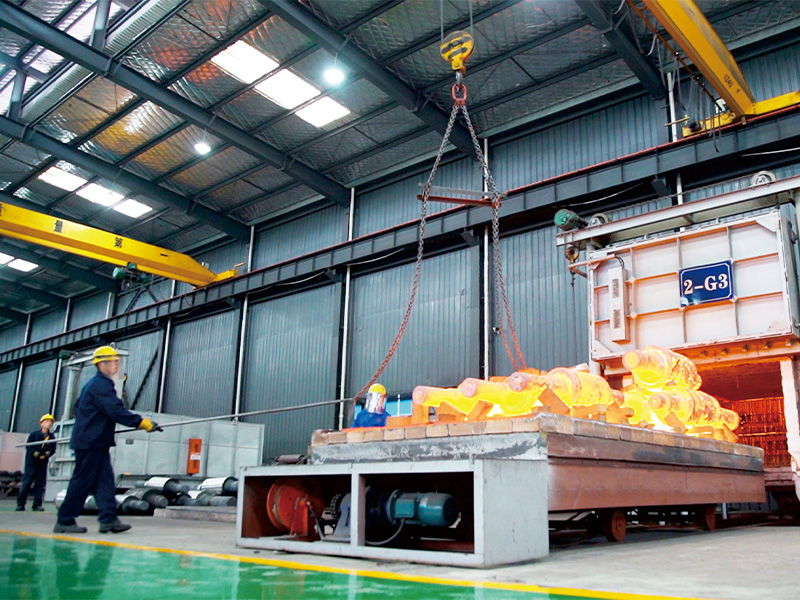
You must establish strict manufacturing standards to qualify bids. Require suppliers to specify their exact manufacturing method. Ask if they use Centrifugal Casting. Check if they use Continuous Pouring for Cladding. See if they employ Hot Isostatic Pressing. Mandate guarantees on the metallurgical bond integrity. The interface zone between the HSS shell and the core material must be flawless. Any porosity or slag inclusion at this interface will cause the shell to spall off during operation.
Heat treatment protocols define the final microstructure. Detail the necessity of controlled, multi-stage heat treatments. The roll needs hardening followed by multiple high-temperature tempering cycles. This eliminates retained austenite. It converts it to stable tempered martensite. Specify the target microstructure requirements. You want a fine dispersion of wear-resistant alloy carbides. These include MC, M2C, and M6C types. They must sit in a tempered martensite matrix. This prevents dimensional deformation and micro-cracking.
Inspection requirements must be mandatory. List the testing reports you expect. Demand the following Non-Destructive Testing (NDT) procedures:
Ultrasonic Testing (UT) across the entire barrel to verify shell-to-core bond integrity and locate internal voids.
Dye Penetrant Testing (PT) on the roll necks and barrel edges to detect microscopic surface cracks.
Magnetic Particle Testing (MT) for identifying sub-surface defects near the drive ends.
Comprehensive surface hardness mapping taking measurements at 100mm intervals across the barrel length.
Specify strict adherence to international material standards like ASTM, ISO, or EN. Do not accept internal, proprietary testing standards unless they map directly to recognized international codes.
Procurement teams must weigh bids beyond upfront quotes. A higher initial quote often yields better long-term value. Suppliers utilizing advanced alloying elements charge more initially. They use Vanadium. They add Molybdenum. They include Tungsten and Niobium. These elements drastically improve wear resistance. You will experience fewer roll changes. You will need fewer grinding passes to restore the profile. This keeps the mill running longer and produces more saleable steel per shift.
Assessing supplier technical expertise is vital. Evaluate their track record in troubleshooting roll wear profiles. Check their ability to provide custom chemistry adjustments. They should base these adjustments on your specific mill data. Investigate their post-sales technical support. Assess their failure analysis capabilities. A true partner helps you optimize the mill, not just supply a consumable. If a vendor simply quotes a price without asking questions about your cooling water or stand positions, they are likely selling a generic product that will underperform.
Common errors during the ordering phase cause severe headaches. Misaligned expectations on lead times disrupt maintenance schedules. HSS roll manufacturing is a slow process. It is a highly controlled metallurgical operation. Mitigate production delays by establishing clear milestones. Set dates for casting. Establish timelines for heat treatment. Define testing and final machining deadlines. Demand weekly progress reports with photographic evidence of the roll at each manufacturing stage.
Inadequate warranty terms leave you exposed. Ensure your request demands clear performance guarantees. Address premature spalling directly. Cover core-shell interface separation. Define abnormal wear parameters. Include penalties for failing to meet the specified hardness gradient. Strong warranty terms force suppliers to maintain strict quality control. If a supplier refuses to back their product with a tonnage guarantee or a clear replacement policy for manufacturing defects, remove them from your approved vendor list.
A well-structured HSS Roll RFQ is the foundation for selecting the right High Speed Steel Mill Roll and achieving long-term rolling performance. By clearly defining technical specifications, operating conditions, quality requirements, and inspection standards, buyers can reduce procurement risks, improve roll service life, and maximize production efficiency.
About Anhui Huanbowan High Speed Steel Mill Roll
Anhui Huanbowan High Speed Steel Mill Roll is a professional manufacturer specializing in high-performance mill rolls for hot strip mills, bar mills, wire rod mills, and section mills. With advanced casting technology, strict heat treatment processes, comprehensive quality inspection, and extensive industry experience, the company provides durable, high-wear-resistant mill rolls that help steel producers improve productivity and reduce operating costs.
Clearly define your mill operating conditions before requesting quotations.
Specify metallurgy, hardness, cooling conditions, and quality inspection requirements in every RFQ.
Evaluate suppliers based on technical expertise, manufacturing capability, and long-term roll performance rather than price alone.
Request complete manufacturing, heat treatment, and NDT documentation to ensure consistent product quality.
Before selecting a High Speed Steel Mill Roll supplier, verify their manufacturing process, quality assurance system, technical support capabilities, and proven rolling mill application experience to achieve the best long-term value.
A: Standard lead times range from three to six months. This accounts for complex centrifugal casting. It includes extensive multi-stage heat treatment processes. Precision final grinding also requires significant time to meet exact tolerances.
A: HSS materials exhibit high thermal expansion. Inadequate cooling leads to severe thermal fatigue. It causes rapid fire-cracking. Suppliers need water pressure and volume data to guarantee the roll's thermal stability.
A: No. Suffixes like HSS-Co or HSS-G apply only to small cutting tools and drill bits. Mill rolls require entirely different, large-scale cast or forged bimetallic metallurgical structures.
A: You must mandate comprehensive Ultrasonic Testing (UT). This verifies the metallurgical bond integrity between the hard outer shell and the tough inner core, ensuring no delamination occurs during rolling.
A: Early stands require high toughness to resist thermal shocks and heavy reductions. Later finishing stands require maximum hardness and wear resistance to maintain strict strip surface quality and profile.