Views: 0 Author: Site Editor Publish Time: 2026-07-27 Origin: Site
Selecting the correct roll material directly dictates rolling mill profitability, operational efficiency, and the overall cost per ton of rolled steel. Unplanned mill downtime caused by premature roll wear or catastrophic failure quickly erodes operating margins. Mill operators face an ongoing engineering challenge in hot rolling environments: balancing the need for extreme wear resistance to maintain strict product tolerances against the necessity of fracture toughness to survive high-impact loads. The choice between high-speed steel and cemented carbide solutions requires a deep understanding of mill stand placement, cooling infrastructure, and target product profiles. Different stages of the rolling process demand entirely different metallurgical properties. This technical evaluation explores the performance characteristics, application specificities, and operational requirements of both materials. By understanding the mechanical limits and advantages of each option, rolling mill engineers can optimize their stand configurations to maximize continuous production and minimize maintenance interruptions.
Application Specificity: HSS rolls deliver superior fracture toughness and thermal fatigue resistance, making them optimal for roughing and early intermediate stands, whereas tungsten carbide roll rings provide unmatched hardness for finishing blocks.
The Composite Alternative: For intermediate stands rolling deformed steel bar and common wire, cemented carbide composite rolls offer a bridge technology, combining the toughness of a steel shaft with the wear resistance of carbide rings.
Performance Metrics: Tungsten carbide rolls typically yield significantly higher tonnage per single groove (often up to 10-20x more than conventional steel and significantly outperforming HSS in finishing stages) due to high-temperature red hardness and superior high-temperature strength.
Implementation Realities: Upgrading to tungsten carbide requires rigorous assessment of mill alignment, water cooling pressure, and handling protocols to mitigate the inherent brittleness of cemented carbide.
Table of Contents
Hot rolling long steel products subjects mill equipment to extreme operational demands. Materials endure high rolling speeds, severe thermal cycling, and continuous mechanical stress. The friction generated during the reduction process creates immense heat, requiring robust cooling systems that simultaneously introduce thermal shock. Rolls must maintain their structural integrity while continuously biting and deforming the steel billet or bloom at temperatures often exceeding 1000°C. In modern wire rod mills, finishing speeds can reach up to 120 meters per second, amplifying the kinetic energy and frictional wear on the roll passes.
Evaluating roll performance requires analyzing several primary metrics. These dimensions dictate how long a roll can stay in the mill before requiring maintenance or replacement. Mill superintendents track these variables daily to optimize pass schedules and minimize cobbles.
Wear resistance: The ability to maintain groove profile and dimensional accuracy over extended campaigns, directly impacting the dimensional tolerance of the finished steel.
Thermal shock and heat checking resistance: The capacity to withstand rapid heating from the hot steel and immediate quenching from the cooling water headers without developing deep surface cracks.
High-temperature structural strength and deformation resistance: Maintaining yield strength at elevated rolling temperatures to prevent groove flattening under heavy reduction loads.
Surface finish quality: The impact of the roll surface on the final rolled product, which is strictly monitored for wire, bar, or tube applications.
Campaign length: The single-groove rolling volume achievable before redressing or replacement is necessary, usually measured in tons per millimeter of wear.
The operational environment dictates that no single material excels in all these categories. Roughing stands prioritize impact resistance due to the large cross-section of the incoming billet and the heavy reduction ratios. Finishing stands prioritize wear resistance and surface finish, as the product is near its final dimensions and traveling at maximum velocity. This dichotomy forces operators to strategically deploy different roll materials across the mill layout.
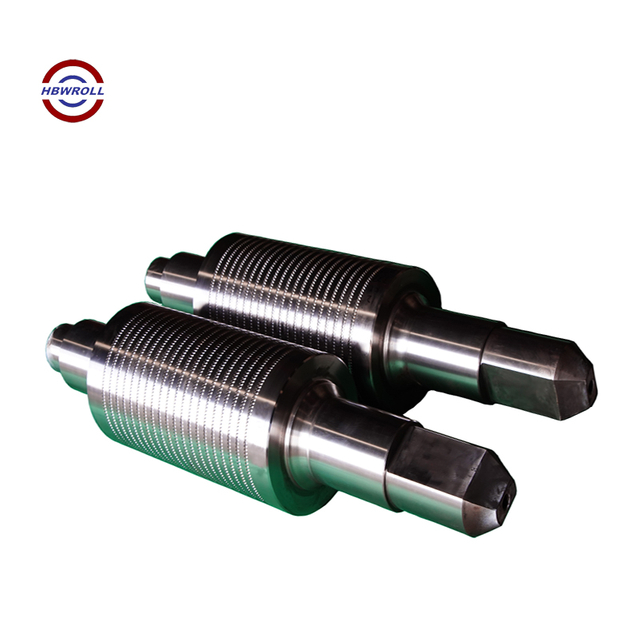
The metallurgical composition of HSS makes it exceptionally well-suited for specific rolling applications, particularly in the early stages of the mill. The microstructure features a high carbon content (typically between 1.5% and 2.5%) combined with complex carbide-forming elements, including tungsten, molybdenum, vanadium, and chromium. These elements are distributed evenly throughout a tempered martensitic matrix. This specific structure provides a unique balance of hardness and impact resistance that traditional cast iron or low-alloy steel rolls cannot match.
During the manufacturing process, HSS rolls undergo specialized heat treatments, including multiple tempering cycles, to relieve internal stresses and achieve the desired hardness profile. The resulting material exhibits a hardness drop-off curve that is much more gradual than standard high-chromium iron, allowing it to maintain its wear characteristics deeper into the roll barrel. This deep hardness penetration extends the overall usable life of the roll before it must be scrapped.
This composition translates directly to operational outcomes on the mill floor. High toughness allows the roll to absorb massive impact forces in early stands. This characteristic significantly reduces the risk of deep spalling or catastrophic breakage when heavy reductions are applied to cold-headed billets or during erratic mill feeding. Furthermore, the material exhibits excellent bite characteristics. The natural friction coefficient ensures reliable material bite in roughing applications, preventing slippage and cobbles during initial passes.
However, limitations exist. In high-speed finishing stands, the material is susceptible to rapid wear compared to harder cemented carbide alternatives. The localized temperatures in the roll bite during high-speed finishing can exceed the tempering temperature of the steel, leading to a localized softening effect known as thermal degradation. This accelerated wear leads to profile degradation, loss of product tolerance, and necessitates more frequent roll changes, interrupting continuous production lines.
HSS Grade Type | Primary Alloying Elements | Typical Hardness (Shore C) | Best Mill Application |
|---|---|---|---|
Standard HSS | W, Mo, V, Cr | 75 - 82 | Roughing Stands |
High-Vanadium HSS | V (High), Mo, Cr | 80 - 85 | Intermediate Stands |
Enhanced HSS | W, Mo, V, Co | 82 - 88 | Pre-Finishing Stands |
A tungsten carbide roll relies on a cemented carbide matrix, representing a massive leap in wear resistance technology. This structure consists of extremely hard tungsten carbide (WC) particles bonded together with a metallic binder, typically cobalt (Co) or a nickel-chromium (Ni-Cr) alloy. The manufacturing process involves powder metallurgy, where the WC and binder powders are milled, pressed into ring shapes, and sintered at temperatures near 1400°C. During sintering, the binder melts and wets the WC particles, creating a dense, virtually void-free composite material.
The percentage of this metallic binder directly controls the hardness-to-toughness ratio of the finished ring. Lower binder content (e.g., 6% to 9% Cobalt) increases hardness and wear resistance, making these grades suitable for the final finishing passes where impact is minimal but abrasion is severe. Higher binder content (e.g., 12% to 15% Cobalt) improves impact resistance and fracture toughness, allowing these grades to be used in pre-finishing or intermediate stands where some mechanical shock is expected.
Mills utilize both solid rings and composite configurations. Solid rings are typically deployed in high-speed finishing blocks, such as Morgan vee-mills, where they are mounted on cantilevered shafts. Cemented carbide composite rolls feature carbide rings mechanically or thermally bonded to a steel arbor. These composite structures are ideal when the application requires the wear resistance of carbide but the bending strength and overall dimensions of a traditional steel shaft, often used in intermediate stands rolling deformed bar.
The operational benefits are substantial. High-temperature red hardness ensures the material maintains structural integrity, yield strength, and wear resistance even at elevated rolling temperatures up to 800°C. Excellent thermal conductivity dissipates heat rapidly away from the roll bite. This minimizes surface degradation and thermal fatigue, ensuring a superior surface finish on common wire and deformed steel bar. The dimensional stability of carbide allows mills to roll to negative tolerances, saving material and increasing yield.
The primary limitation is low fracture toughness. The inherent brittleness makes these rings highly sensitive to mechanical shocks, cobbles, and improper cooling protocols. Mishandling during roll changes, such as striking the ring with a steel tool or setting it down too hard on a concrete floor, can cause micro-cracks that propagate into catastrophic failures under rolling loads. Furthermore, sudden loss of cooling water during rolling will cause immediate thermal shock and shattering.
Evaluating HSS vs tungsten carbide roll performance requires analyzing how each material behaves under continuous hot rolling conditions. The abrasion resistance curves differ significantly. Cemented carbide maintains its groove profile far longer, often achieving single-groove rolling volume multiples vastly exceeding those of steel alternatives. In a typical wire rod finishing block, a carbide ring might roll 1,500 to 3,000 tons per groove, whereas a steel equivalent might only manage 150 to 300 tons before the profile degrades beyond acceptable tolerances.
Fracture toughness presents a direct trade-off. Steel alloys easily withstand heavy reductions, sudden impacts from cold billet ends, and the general mechanical abuse common in roughing mills. Conversely, carbide is vulnerable to impact-induced micro-cracking. A cobble in a roughing stand might leave a small dent in a steel roll that can be ground out; the same cobble would likely shatter a carbide roll into pieces.
Thermal dynamics also contrast sharply. Steel offers strong thermal fatigue resistance, handling the cyclic heating and cooling of the rolling process with predictable, manageable heat checking (fine surface cracking). Carbide provides superior thermal conductivity but poor thermal shock resistance. This dictates how each material reacts to cooling water application; carbide requires highly controlled, high-pressure cooling (often exceeding 10 bar) applied continuously to the groove to prevent thermal shock. If the water is interrupted even for a few seconds while steel is in the pass, the carbide ring will likely crack.
Maintenance infrastructure requirements differ drastically. Steel requires standard CNC roll grinding equipment using conventional aluminum oxide or silicon carbide grinding wheels. Cemented carbide necessitates specialized, high-rigidity grinding machines equipped with resin-bonded diamond grinding wheels. The grinding parameters for carbide—wheel speed, feed rate, and coolant application—must be strictly controlled to prevent inducing thermal cracks during the redressing process.
Technical Parameter | High-Speed Steel (HSS) | Tungsten Carbide (WC-Co) |
|---|---|---|
Matrix Structure | Tempered Martensite + Carbides | WC Particles + Metallic Binder |
Hardness Range | 75 - 88 Shore C | 78 - 85 HRA (Much harder) |
Fracture Toughness | High (Impact resistant) | Low (Brittle, shock sensitive) |
Thermal Conductivity | 20 - 25 W/m·K | 80 - 100 W/m·K |
Cooling Water Requirement | Standard volume, moderate pressure | High volume, high pressure (>10 bar) |
Redressing Equipment | Standard Grinder (Al2O3 wheels) | Rigid Grinder (Diamond wheels) |
Roughing and early intermediate stands require materials that can handle heavy reduction passes and large cross-sections. Impact resistance is paramount here. The incoming billet is relatively slow-moving, but the reduction forces are massive. High-speed steel remains the industry standard for these positions, absorbing the initial shock of the billet entering the mill without sustaining structural damage. The excellent bite characteristics of HSS also prevent slippage, which is critical in these early passes to maintain continuous tension-free rolling.
Intermediate stands represent a transition zone. The steel is moving faster, the cross-section is smaller, and the demand for wear resistance increases. Here, operators often deploy enhanced HSS grades with higher vanadium content or begin introducing cemented carbide composite rolls. The composite rolls offer a strategic advantage: the steel arbor handles the bending moments and torque, while the carbide rings provide extended pass life, reducing the frequency of roll changes in the middle of the mill.
Pre-finishing and finishing mills operate under entirely different parameters. High-speed blocks demand extreme dimensional accuracy. Maintaining tight tolerances on wire rod, deformed steel bar, and thin-walled tubes is critical for meeting customer specifications. Here, operators transition exclusively to solid cemented carbide rings to leverage their exceptional wear resistance and high-temperature strength. The high rolling speeds (often exceeding 100 m/s) generate intense frictional heat, which the carbide's high thermal conductivity helps dissipate, preventing surface defects on the finished product.
Pinch rolls and sizing blocks often utilize precision composite rolls or specialized solid carbide grades. Specific carbide grades with lower binder content are tailored for these final sizing operations, ensuring the finished product meets exact dimensional specifications while maintaining an excellent surface finish. The sizing block is the last point of contact before the cooling bed, making the roll surface condition absolutely critical.
Mounting brittle materials presents a significant engineering challenge. Traditional keyway mounting, common with steel rolls, is entirely unsuitable for cemented carbide rings. Keyways create localized stress concentrations. When rolling torque is applied, these stress risers rapidly lead to crack propagation and catastrophic ring failure. The brittle nature of carbide means it cannot yield or deform to relieve these stresses; it simply fractures.
Advanced clamping technologies are mandatory for utilizing carbide rings on cantilevered shafts or composite arbors. Hydraulic clamping systems are the most prevalent solution. These systems use hydraulic pressure to expand a tapered sleeve, achieving a uniform interference fit against the inner diameter of the carbide ring. This method distributes the clamping force evenly across the entire inner surface, eliminating stress concentrations and ensuring perfect concentricity.
Mechanical nut and torque sleeve systems provide an alternative for specific mill designs. These systems use precision-machined threads and torque multipliers to apply precise axial clamping forces. The axial force compresses the ring between two flanges, relying on friction to transmit the rolling torque. These systems prevent rotational slippage under high rolling torque without inducing damaging radial stress on the carbide.
Maintenance protocols must strictly control clamping torque and hydraulic pressures. Applying the correct torque prevents premature ring cracking and ensures absolute concentricity, which is vital for high-speed finishing operations. Any runout or eccentricity in the mounted ring will cause gauge variations in the rolled product and induce vibration in the mill stand, accelerating bearing wear. Technicians must use calibrated torque wrenches and follow strict cleanliness protocols during mounting, as even a small piece of scale trapped between the ring and the arbor can cause the ring to crack when clamped.
Cooling water infrastructure requires rigorous auditing before upgrading roll materials to cemented carbide. Carbide demands strict control over cooling water pressure, volume, and quality. Operators must ensure header pressures exceed 10 bar to break through the steam boundary layer generated during high-speed rolling. Water quality is equally critical; operators must monitor pH levels (maintaining neutrality between 7 and 8) and strictly limit suspended solids. Abrasive particles in the water will erode the metallic binder in the carbide, leading to premature surface degradation. Inadequate cooling or sudden temperature fluctuations will cause immediate thermal cracking.
Handling and mounting protocols must be completely overhauled when transitioning from steel to carbide. Mechanical damage during roll changes is a significant risk. Technicians must use precision hydraulic clamping systems and specialized lifting equipment, such as soft slings or custom C-hooks, to avoid stress concentrations or impact damage. Dropping or striking a carbide ring with a hard tool will cause irreparable damage. Roll shop personnel require specific training on the handling characteristics of brittle materials.
Mill alignment and cobble management are critical for protecting carbide investments. Strict guide alignment prevents cobbles and ensures the steel enters the pass perfectly centered. While a steel roll might only sustain minor surface damage during a cobble, the same event can easily shatter a brittle carbide roll, leading to extended downtime and costly replacements. Operators must implement robust cobble detection systems and ensure all entry and delivery guides are precisely calibrated.
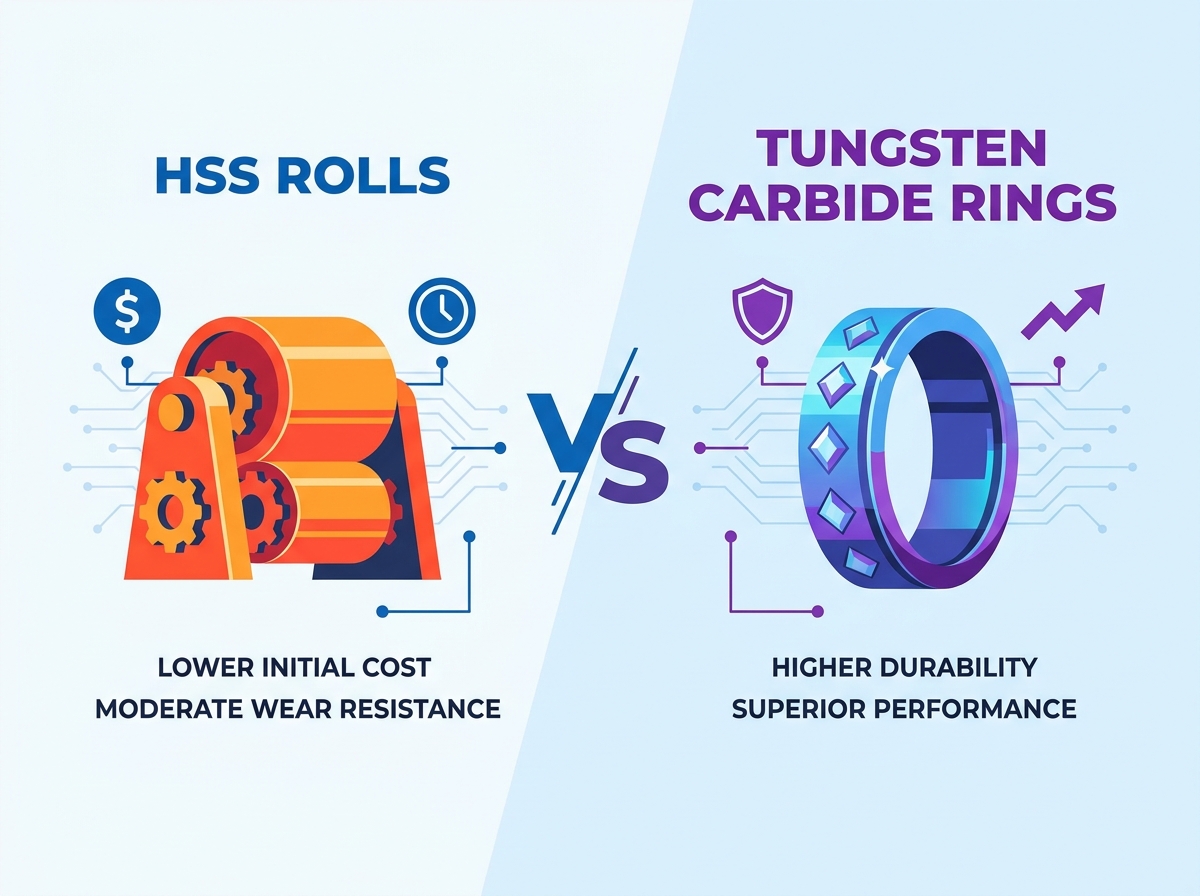
The choice between High-Speed Steel (HSS) rolls and Tungsten Carbide roll rings depends on rolling speed, mill stand position, production targets, and maintenance capabilities. Selecting the right roll material for each application helps maximize campaign life, improve product quality, reduce downtime, and achieve higher overall mill efficiency.
About Anhui Huanbowan High Speed Steel Mill Roll
Anhui Huanbowan High Speed Steel Mill Roll is a professional manufacturer of High-Speed Steel mill rolls and advanced rolling mill solutions for hot strip mills, bar mills, wire rod mills, and section mills. With advanced alloy technology, precision casting, optimized heat treatment, and strict quality inspection, the company provides durable, high-performance roll solutions that help steel manufacturers improve rolling efficiency, extend roll service life, and reduce production costs.
Use HSS rolls for roughing and intermediate stands where impact resistance and thermal fatigue performance are critical.
Choose Tungsten Carbide roll rings for high-speed finishing stands that require exceptional wear resistance and dimensional accuracy.
Ensure cooling systems, clamping equipment, and grinding capabilities meet the operational requirements of carbide rolls.
Work with experienced manufacturers that offer customized roll solutions and professional technical support.
Before selecting HSS rolls or Tungsten Carbide roll rings, verify the mill stand application, alloy composition, cooling requirements, maintenance infrastructure, and supplier expertise to maximize long-term rolling performance and return on investment.
A: The primary difference lies in their mechanical properties and microstructure. HSS offers superior fracture toughness and impact resistance, making it ideal for heavy reductions. Tungsten carbide provides exceptional hardness and wear resistance, maintaining groove profiles significantly longer in high-speed finishing applications.
A: Generally, no. Roughing stands subject rolls to severe mechanical shocks, heavy reduction forces, and large temperature gradients. The inherent brittleness of cemented carbide makes it highly susceptible to shattering under these high-impact conditions.
A: High thermal conductivity allows the roll to dissipate heat rapidly away from the roll bite. This minimizes surface degradation on the roll itself, which in turn ensures a smoother, more consistent surface finish on the final rolled product.
A: They require high-pressure (often >10 bar), high-volume cooling water applied consistently to the groove. The water must be clean, with controlled pH levels and minimal suspended solids, to prevent thermal shock and binder erosion.
A: Depending on the specific application and mill conditions, a cemented carbide roll can achieve a single-groove rolling volume 10 to 20 times greater than conventional steel rolls in finishing stands.
A: Traditional keyways create localized stress concentrations that cause brittle carbide to crack under rolling torque. Specialized hydraulic or mechanical clamping systems provide uniform pressure, preventing slippage without inducing damaging radial stress.