Views: 0 Author: Site Editor Publish Time: 2026-08-05 Origin: Site
The financial and operational correlation between rolling mill tooling degradation and final product rejection rates is a constant reality in steel manufacturing. Unmanaged wear compromises rib geometry across the entire production run. This leads to out-of-tolerance products and structural bonding failures in the field. It also causes a complete loss of negative tolerance control, directly impacting mill profitability. We must shift focus from reactive roll replacement to proactive evaluation of roll materials, pass design optimization, and condition monitoring systems. This approach maximizes tonnage per campaign and protects the bottom line.
Quality Degradation: Progressive wear directly alters rib height and spacing, causing critical appearance defects and reducing the mechanical grip required for concrete reinforcement.
Yield Loss: Poor groove condition destabilizes negative tolerance rolling, forcing mills to produce heavier-than-necessary rebar and sacrificing profit margins.
Material Selection: Upgrading from standard cast iron to advanced composite or tungsten carbide rolls requires balancing upfront costs against extended campaign life and machining complexities.
Risk Mitigation: Optimizing roll pass design and cooling parameters is essential to prevent surface thermal cracking and premature groove failure.
Table of Contents
The finishing stand operates in an extreme environment where high-pressure contact and cyclic temperature fluctuations dominate the rolling process. Steel enters the finishing stands at temperatures often exceeding 950 degrees Celsius. The rolls themselves are continuously blasted with high-pressure cooling water. This extreme temperature differential creates massive thermal shock on the roll surface. Thermal shock creates surface thermal cracks inside the groove. These fire cracks propagate rapidly under continuous stress. They eventually cause material spalling on the roll surface, leaving rough patches that damage the passing steel.
Iron oxide scale adds severe abrasive action during high-speed rolling. As the hot billet passes through the stands, scale breaks off and acts like a grinding compound between the steel and the roll groove. This friction accelerates degradation across the entire pass. Operators must monitor these thermal cycles closely. Managing heat distribution prevents catastrophic surface failure. Consistent cooling application remains critical for longevity. When water headers clog or nozzles misalign, localized dry spots form on the roll. These spots overheat instantly, leading to deep fire cracking and premature roll failure.
The hot steel billet enters the groove, transferring intense heat to the roll surface.
High-pressure water immediately quenches the roll as it rotates out of the bite.
The rapid expansion and contraction create microscopic surface fractures.
Abrasive iron oxide scale enters these fractures, widening them during subsequent passes.
The weakened surface material spalls off, destroying the groove profile.
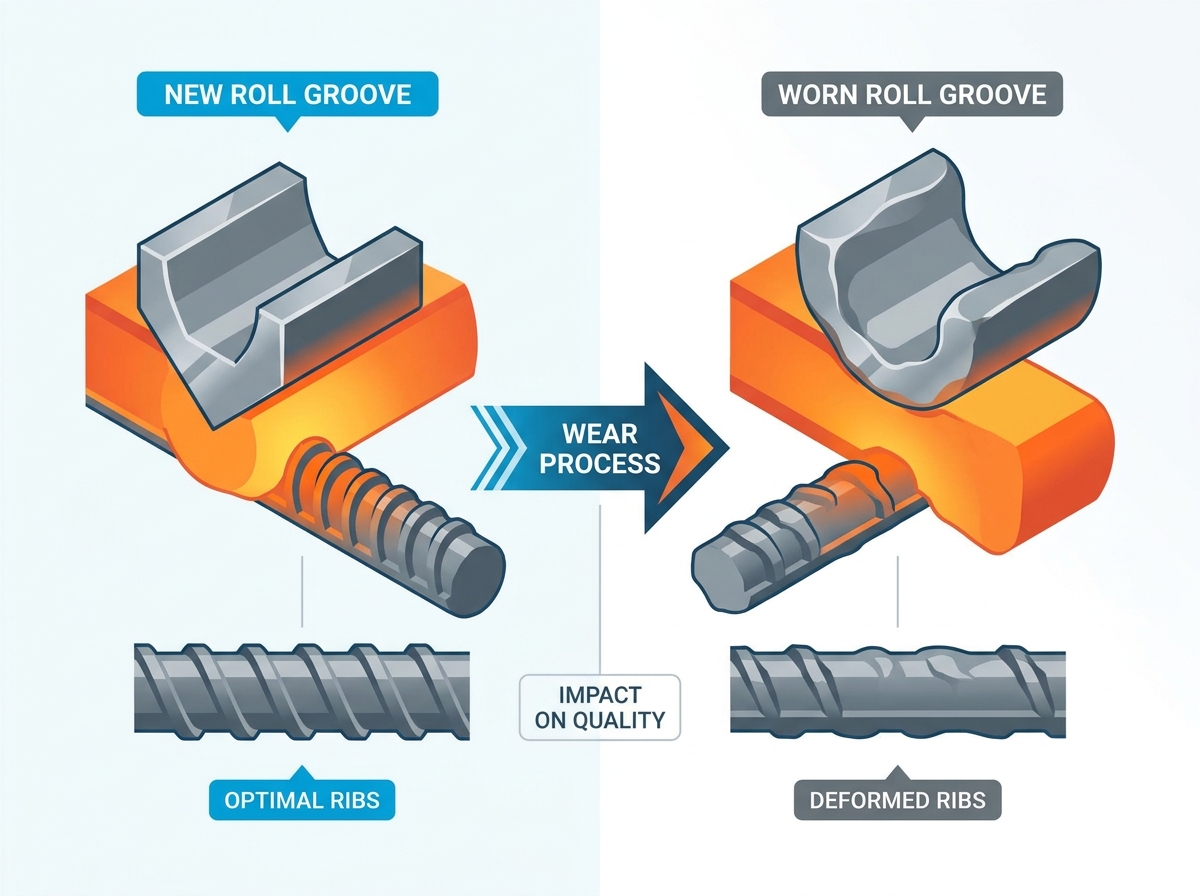
Degradation patterns emerge clearly in the rib-forming indentations of the roll pass. The groove widens and becomes shallow over time. This directly reduces rebar rib height and alters the flank angle. Different rib profiles dictate localized roll chipping. Crescent-shaped and bamboo-style ribs show varying rates of progressive rebar roll groove wear. Metallurgical studies confirm these geometry differences influence chipping susceptibility. Sharp angles create stress risers inside the groove. Gradual profiles distribute the rolling force more evenly.
Controlling this geometry extends the operational life of the roll. When the indentations wear down, the resulting rebar lacks the necessary rib volume. The base of the groove also flattens, changing the core diameter of the rebar. This dimensional shift forces operators to adjust roll gaps constantly to maintain section weight. Eventually, the groove degrades beyond the point where gap adjustments can compensate. At this stage, the pass must be changed to prevent rolling out-of-spec material.
Negative tolerance rolling is crucial for mill profitability. It means producing rebar at the lower limit of allowable weight per meter. Rapid roller wear ruins material control. The rebar cross-section swells as the groove expands. This pushes the product into positive weight deviation. Mills end up giving away free steel. Worn grooves destroy profit margins rapidly. Maintaining strict dimensional control requires frequent groove inspections. Operators must track weight deviation per billet. This data highlights the exact moment a groove fails.
When a mill targets a negative 4% tolerance, every millimeter of groove wear eats into that margin. As the groove widens, the steel fills the extra space. The weight per meter creeps up to negative 2%, then to zero, and eventually into positive territory. The mill is now consuming more raw billet to produce the same length of finished rebar. Over a month of production, this weight deviation translates to hundreds of tons of lost yield. Strict monitoring of the section weight is the only way to catch this drift before it impacts the monthly financial performance.
Improper roll turning or dull redressing tools leave poor groove finishes. This transfers micro-roughness to the rebar surface. These pockets trap moisture and accelerate severe rust. Degraded grooves also cause longitudinal seams, overfills, and irregular rib spacing. Worn ribs have severe structural consequences. Degraded profiles shift the concrete-rebar bonding mechanism. High-strength mechanical interlocking becomes low-strength frictional resistance. The rebar acts like a smooth rod. It fails to meet international standards like ASTM, DIN, or BS.
This leads to client rejection. Prime rebar gets downgraded to scrap or secondary markets. Construction engineers rely on specific rib heights to calculate the load-bearing capacity of reinforced concrete. When a mill ships rebar with shallow ribs, the concrete cannot grip the steel effectively. Under heavy tensile loads, the rebar can slip inside the concrete matrix. This slippage compromises the structural integrity of the entire building. Quality control teams must use profile gauges to verify rib height on every bundle before it leaves the cooling bed.
Defect Type | Root Cause in Roll Groove | Impact on Final Product |
|---|---|---|
Shallow Ribs | Worn rib indentations in the pass | Loss of mechanical bonding in concrete |
Longitudinal Fins | Overfilled groove due to wear | Handling hazards and weight deviation |
Surface Roughness | Fire cracking and spalling | Accelerated rusting and poor aesthetics |
Irregular Spacing | Uneven wear along the roll circumference | Failure to meet structural standards |
Standard cast iron and nodular iron offer a baseline performance. They provide easy redressing and lower initial costs. However, they require frequent groove changes. Tungsten carbide rings deliver superior wear resistance. They significantly extend the tonnage per campaign. You must evaluate the cost-per-ton of rolled steel. Ignore the initial purchase price of the rolls. Focus on long-term campaign value. Harder materials resist abrasive scale better. They maintain rib geometry for longer periods. This stability improves overall mill efficiency.
Switching to tungsten carbide requires a complete overhaul of roll shop practices. These rings cannot be turned on standard lathes. They require specialized CNC grinding machines equipped with diamond wheels. The initial capital expenditure for this equipment is significant. However, the operational savings justify the investment. Tungsten carbide can roll up to ten times the tonnage of standard cast iron before requiring a groove change. This massive reduction in mill downtime directly increases the overall production capacity of the plant.
Modern roll pass design software simulates metal flow accurately. This reduces localized stress concentrations on the groove. Optimized rib geometries distribute rolling pressure evenly. This reduces chipping and extends groove life. CNC roll turning lathes ensure precise, repeatable groove cutting. They match the optimized design perfectly. Manual turning introduces human error. Automated machining guarantees exact rib depth. This precision translates directly to better rebar quality. Engineering teams must review pass designs annually. Continuous improvement prevents recurring wear patterns.
The transition from oval-round sequences to more advanced pass designs can also reduce the wear on the finishing stand. By controlling the spread of the material in the intermediate stands, the finishing groove receives a more consistent entry section. This consistency prevents overfilling and reduces the lateral pressure on the groove walls. Pass designers must work closely with the roll shop to ensure that the theoretical designs can be machined accurately. A perfect design is useless if the lathes cannot reproduce the required tolerances.
Inline laser profile gauges monitor rebar geometry in real-time. Optical measurement systems provide continuous feedback. Automated alerts for rib height degradation change how operators work. They can change grooves based on data instead of arbitrary time intervals. These systems scale effectively across multiple finishing stands. Real-time data eliminates guesswork. It prevents out-of-spec rolling before it happens. Integrating these sensors requires network infrastructure. The investment pays off through scrap reduction.
Traditional mills rely on manual caliper checks at the cooling bed. This method introduces a massive delay between the occurrence of a defect and its detection. By the time an operator measures a shallow rib, several tons of defective rebar have already been rolled. Inline systems scan the hot steel immediately after the finishing stand. If the rib height drops below the acceptable threshold, the system triggers an alarm in the pulpit. The operator can then switch to a fresh groove immediately, minimizing the production of secondary material.
Calculating the return on investment requires a clear framework. Upgrading roll metallurgy or pass design requires upfront capital. You must factor in the reduction of mill downtime. Fewer roll changes per shift increase overall equipment effectiveness. Every minute of uptime generates revenue. Extended campaigns reduce labor costs in the roll shop. You spend less time redressing worn grooves. The cost-per-ton metric provides the most accurate financial picture. Compare historical data against the upgraded performance.
A standard groove change takes approximately five to ten minutes, depending on the mill setup. If a mill changes grooves four times a shift, that is up to forty minutes of lost production. Over a year, this downtime adds up to thousands of tons of lost capacity. By upgrading to wear-resistant materials, a mill might reduce groove changes to once per shift. The revenue generated from this recovered production time far outweighs the higher purchase price of the advanced rolls. Financial teams must track these metrics to validate the engineering upgrades.
Maintaining strict negative tolerance stability brings massive financial benefits. You save money throughout the entire roll campaign. Reducing the percentage of rejected rebar generates direct savings. Out-of-spec rib dimensions cost money. Appearance defects destroy product value. Consistent groove geometry ensures consistent product weight. This predictability allows for better production planning. Sales teams can guarantee product specifications confidently. Yield improvement directly funds future mill upgrades.
Scrap reduction is another major financial driver. When a groove fails catastrophically, it can cause a cobble in the finishing block. A cobble destroys the current billet and requires significant downtime to clear the tangled steel. Worn grooves increase the risk of cobbles by destabilizing the metal flow. By changing grooves based on accurate wear data, mills prevent these catastrophic failures. The reduction in cobble-related scrap and downtime further improves the cost-per-ton metrics of the rolling operation.
Harder, wear-resistant rolls require specialized diamond grinding equipment. Tungsten carbide is difficult to machine. You risk bottlenecks in the roll shop. Poor groove surface quality happens without proper calibration. Operators need specialized training to prevent bad holes. Dull cutting tools create micro-fractures in the groove. These fractures expand during rolling. Upgrading materials means upgrading the roll shop simultaneously. You cannot maintain advanced rolls with outdated equipment.
The roll shop environment must be strictly controlled. Diamond grinding wheels require precise coolant application to prevent thermal damage to the carbide rings. If the grinding process generates too much heat, the carbide can crack before it even reaches the mill. Roll shop operators must measure the finished grooves with high-precision templates or optical scanners. Any deviation from the pass design will cause immediate rolling issues. The transition to harder materials requires a cultural shift in the roll shop towards precision manufacturing.
Roll material upgrades depend heavily on mill cooling infrastructure. Catastrophic roll failure can occur. High-pressure water cooling must be precisely calibrated. This prevents thermal shock on harder roll materials. Conduct a thorough audit of water pressure. Check nozzle alignment and water quality before upgrading rolls. Clogged nozzles create dry spots on the roll. These spots overheat and crack instantly. Consistent water volume prevents surface spalling. Maintenance teams must inspect headers daily.
Water quality is often overlooked during mill upgrades. Suspended solids in the cooling water act as an abrasive slurry, accelerating wear on the roll surface. Furthermore, scale buildup inside the cooling headers restricts water flow and alters the spray pattern. Mills must install adequate filtration systems to ensure clean cooling water. The pressure at the nozzle must be sufficient to punch through the steam boundary layer that forms around the hot roll. Without proper cooling, even the most expensive tungsten carbide rolls will fail prematurely.
Managing rebar roll groove wear drives product quality and yield optimization. It directly impacts mill profitability. Mills experiencing high weight deviation should prioritize inline measurement. Mills suffering frequent downtime should evaluate tungsten carbide upgrades.
Founded in 2007, Anhui Huanbowan High Speed Steel Mill Roll focuses on the manufacture of high-speed steel rolls and mill roll rings for demanding steel-rolling applications. Its roll-manufacturing background provides valuable support for mills evaluating material upgrades, improving groove wear resistance, maintaining profile accuracy, and increasing tonnage per rolling campaign.
Initiate a wear-pattern audit on current finishing rolls to identify failure modes.
Consult with tooling metallurgists regarding material upgrades for specific steel grades.
Calculate the current cost-per-ton of wear to establish a financial baseline.
Audit cooling system alignment and pressure settings before installing harder rolls.
Implement real-time profile measurement to transition from time-based to data-driven groove changes.
A: Rapid wear is primarily caused by a combination of thermal fatigue, abrasive friction from iron oxide scale, and suboptimal roll pass design that concentrates stress on the rib indentations.
A: Sharp angles and deep indentations in the roll pass create stress risers, making the groove more susceptible to chipping and accelerated wear compared to optimized, gradual rib profiles.
A: It is the practice of rolling rebar to the minimum allowable weight per meter specified by industry standards, maximizing the length of rebar produced from a single billet to increase profitability.
A: Groove change frequency should be dictated by tonnage rolled and real-time dimensional monitoring of the rebar, rather than fixed time intervals, as wear rates vary by steel grade and roll material.
A: Common defects include shallow or missing ribs, longitudinal overfills (fins), surface thermal cracks transferred to the steel, and irregular surface textures that promote severe rust.
A: Yes, advanced roll pass design optimizes metal flow and reduces localized pressure, which significantly mitigates chipping and extends the operational life of the groove.