Views: 0 Author: Site Editor Publish Time: 2026-07-27 Origin: Site
Specifying the correct hardness for mill rolls dictates operational longevity and prevents catastrophic mill downtime. Hardness acts as the primary defense against wear, thermal fatigue, and spalling during the intense metal rolling process. A frequent and expensive error happens when procurement teams and metallurgical engineers confuse static indentation measurements with dynamic rebound testing. Misunderstanding the technical mechanics of HRC vs HSD roll hardness leads to flawed procurement specifications, rejected roll shipments, and massive operational delays.
This technical evaluation guide provides a direct framework for metallurgical engineers and procurement teams to understand the mechanics, conversion risks, and application-specific criteria of these testing methods. By mastering how to apply and interpret these standards, you can eliminate the risks of inaccurate measurements, optimize roll performance, and enforce strict quality control protocols directly on the mill floor.
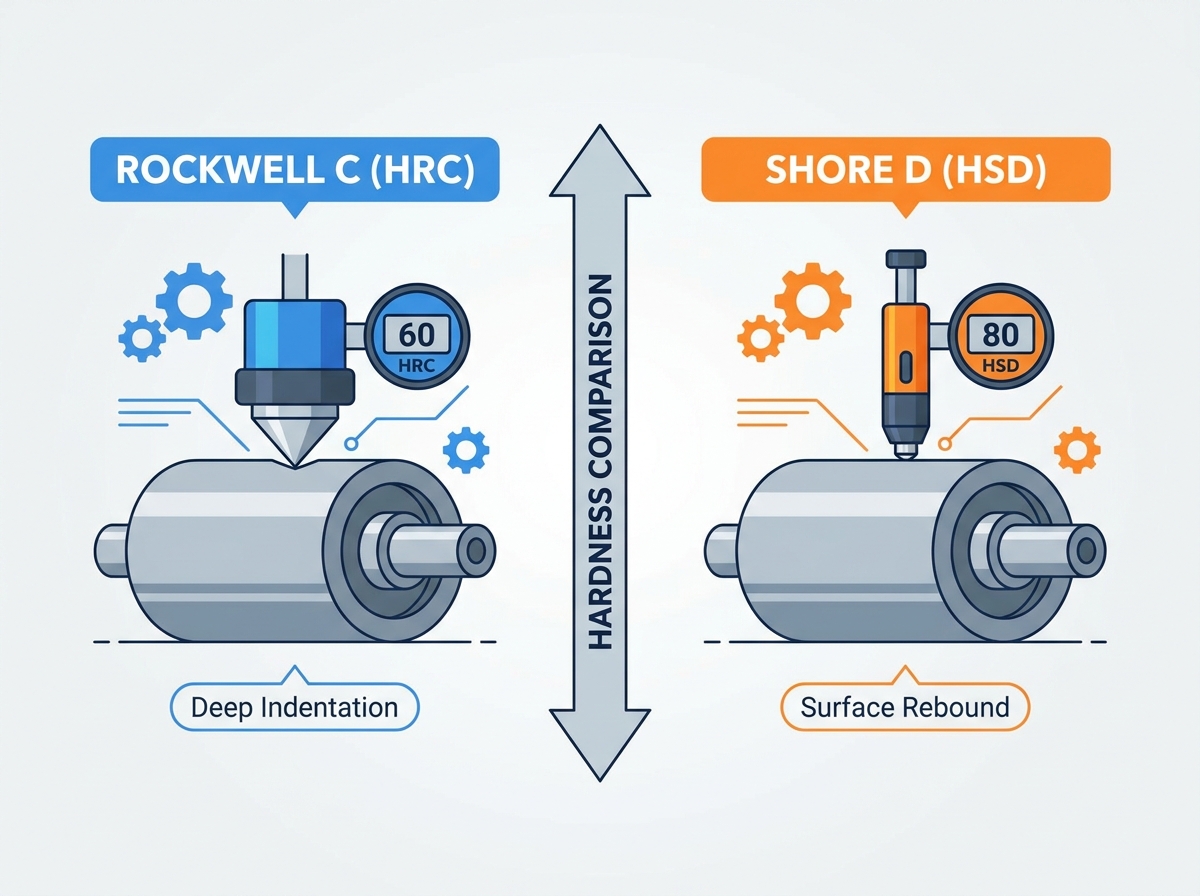
Methodology Differences: HRC measures static penetration resistance (ideal for deep, localized hardness), while HSD measures dynamic elastic rebound (ideal for non-destructive, large-surface testing).
Conversion Fallacies: Direct mathematical conversions between HRC and HSD are inherently flawed for complex roll alloys due to variations in microstructure, carbide volume, and internal stresses.
Application Specificity: HSD remains the industry standard for large, finished mill rolls on the shop floor, whereas HRC is strictly utilized for laboratory-level quality control and smaller forged rolls.
Error Mitigation: Surface preparation, instrument calibration, and operator technique account for the majority of roll hardness detection errors, requiring strict adherence to ISO and ASTM standards.
Table of Contents
The primary objective of roll hardness testing is achieving repeatable, accurate measurements without compromising the roll's surface integrity. Selecting the right testing method depends entirely on the roll's material composition, physical dimensions, and current stage of production.
The Rockwell Hardness C (HRC) scale measures a material's resistance to static indentation. The test applies a specific preliminary minor load followed by a major load of 150 kgf using a 120-degree diamond spheroconical indenter. The permanent depth of penetration determines the final hardness value. This method provides a highly accurate assessment of the material's underlying matrix hardness.
When testing cylindrical rolls, technicians must apply ASTM E18 curvature correction factors to account for the geometric limitations of the curved surface. Without these mathematical corrections, HRC readings on convex surfaces register artificially low. Furthermore, operators must observe a strict rule of indentation spacing. The distance between test points must be at least three times the diameter of the indentation from center-to-center. This prevents work-hardening interference from previous tests.
Because HRC leaves a distinct physical footprint, we consider it a destructive or semi-destructive method. Therefore, mills rarely use it on the working barrel of highly polished finishing rolls. Instead, HRC serves as the baseline material verification standard for forged steel rolls, tool steels, and laboratory-level quality control.
Grind the test area to remove any decarburization layer and achieve a flat, smooth surface.
Apply the preliminary minor load to seat the diamond indenter and establish the zero reference position.
Apply the major load of 150 kgf smoothly and hold for the specified dwell time.
Release the major load and record the depth of permanent indentation to calculate the HRC value.
Apply ASTM E18 curvature correction factors if testing directly on the cylindrical roll body.
Shore Scleroscope Hardness (HSD) operates on the principle of dynamic elastic rebound. The test involves dropping a diamond-tipped hammer from a fixed height inside a glass tube onto the roll surface and measuring the height of the rebound. The rebound height correlates directly with the material's elastic limit and yield strength.
HSD is the dominant standard for large-scale, in-situ testing on the mill floor because it is highly portable and non-destructive. It allows operators to quickly map the hardness profile across the entire barrel of massive finished rolls without leaving damaging indentations that would transfer defects to the rolled product.
Feature | Rockwell C (HRC) | Shore Scleroscope (HSD) |
|---|---|---|
Testing Mechanism | Static indentation (150 kgf load) | Dynamic elastic rebound (dropped hammer) |
Indenter Type | 120-degree diamond spheroconical | Diamond-tipped hammer |
Primary Application | Forged steel, lab testing, deep matrix hardness | Finished cast iron rolls, shop floor NDT |
Surface Impact | Destructive (leaves permanent indentation) | Non-destructive (leaves minimal to no mark) |
Portability | Low (requires rigid bench-top setup) | High (portable tube and hammer system) |
While HRC and HSD are the primary metrics, Brinell (HB) and Vickers (HV) testing play vital supplementary roles in roll manufacturing. Brinell testing utilizes a large tungsten carbide ball indenter, making it ideal for testing soft roll necks and raw cast iron castings. The large indentation averages out the heterogeneous microstructures found in these materials, providing a more representative overall hardness value for the bulk material.
Vickers (HV) microhardness testing serves as the ultimate arbitrator for microstructural phase analysis. Metallurgists use it to evaluate specific microstructural components, such as individual carbides, and to assess the integrity of weld overlay or cladding zones on composite rolls. It provides pinpoint accuracy that bulk testing methods cannot match.
Comparing these methods across critical operational dimensions helps guide accurate specification decisions and ensures you use the right tool for the right application on the mill floor.
Traditional HRC testers require rigid, bench-top setups, limiting their use to smaller rolls or test coupons in a laboratory environment. The roll must be perfectly supported to prevent any deflection during the application of the 150 kgf major load. Conversely, HSD instruments are highly portable, allowing technicians to test massive rolls directly on the shop floor, in the storage racks, or while mounted in a roll grinder.
While portable Leeb hardness testers (HL) are frequently used as proxies for HRC or HSD, they require rigorous calibration against standardized test blocks specific to the roll's exact alloy. Failure to calibrate portable units properly leads to massive measurement errors, often resulting in the acceptance of out-of-spec rolls.
The impact of the test method on the roll barrel dictates its application. HSD is mandated for finishing work rolls because it leaves virtually no mark on the surface. Applying an HRC test to a polished finishing roll creates an indentation that acts as a stress riser. During operation, this indentation transfers a repeating defect onto the rolled metal strip, ruining the product's surface finish and leading to immediate rejection by the customer.
Material composition heavily influences the choice of testing method. HRC is highly effective on homogenous forged steel rolls, where the matrix hardness is uniform throughout the structure. However, HSD is far more practical for heterogeneous cast iron rolls, such as High-Chrome Iron or Indefinite Chill rolls. In these materials, the presence of graphite flakes or massive carbides skews static HRC indentation results. The dynamic rebound of HSD provides a more reliable average of the surface hardness across these complex microstructures.
A common engineering pitfall is relying on generic conversion charts when specifying HRC,HSD roll hardness. These conversions often lead to critical failures in roll performance and massive disputes between mills and roll manufacturers.
Standard ASTM E140 conversion tables were designed for simple carbon steels. These tables break down completely when applied to highly alloyed mill rolls. The complex microstructures of modern rolls create a massive discrepancy between "apparent hardness" (the overall measured value) and "matrix hardness" (the hardness of the underlying steel structure). You cannot use a chart designed for 1045 steel to evaluate a high-speed steel work roll.
Alloy Type | Microstructure Characteristics | Conversion Reliability (HRC to HSD) |
|---|---|---|
Forged Carbon Steel | Homogenous, uniform matrix | High (Standard ASTM tables generally apply) |
Indefinite Chill Iron | Graphite flakes, cementite network | Low (Graphite absorbs impact, skewing HSD) |
High-Chrome White Iron | Massive M7C3 carbides in martensite | Very Low (Carbides cause excessive HSD rebound) |
High-Speed Steel (HSS) | Complex MC and M2C carbides | Very Low (Requires empirical, alloy-specific data) |
Massive carbides in high-speed steel (HSS) or high-chrome rolls affect dynamic rebound (HSD) differently than static penetration (HRC). A roll might exhibit a high HSD value due to the elastic rebound off hard carbides, masking a deficient, soft HRC matrix hardness. Accepting a roll based on a converted HSD value without verifying the actual HRC matrix hardness results in premature wear, rapid degradation of the roll profile, and catastrophic spalling during operation.
Accurate hardness data relies entirely on mitigating real-world variables that compromise testing integrity on the mill floor.
Inadequate grinding, excessive surface roughness, or residual decarburization layers lead to artificially low readings for both HRC and HSD. The roll surface must be ground to a specific Ra value to ensure the indenter or hammer interacts directly with the true base material, not a soft, oxidized outer layer.
Identify the specific test location on the roll barrel, avoiding edges and known defect areas.
Use a portable grinder to remove scale, rust, and any decarburized surface material.
Polish the test spot to achieve a surface roughness (Ra) of 0.8 micrometers or better.
Clean the area with a solvent to remove grinding dust, oil, and coupling fluids.
Perform the hardness test immediately to prevent rapid surface oxidation.
The physical mass of the roll significantly impacts dynamic HSD readings. Hollow, thin-walled, or lightweight rolls absorb the impact energy of the hammer, resulting in artificially low hardness readings. To counter this, smaller rolls must be tested on rigid V-blocks, often using coupling gels and solid steel baseplates to ensure the impact energy is fully reflected back into the scleroscope hammer.
Operator technique is vital, particularly in HSD testing, where maintaining absolute verticality of the scleroscope tube is non-negotiable. Even a slight tilt causes the hammer to drag against the glass tube, reducing rebound height and yielding a false low reading. Furthermore, equipment degradation, such as micro-chipping of the HRC diamond cone or wear on the Shore hammer tip, distorts readings. Regular calibration using standardized test blocks specific to the roll's alloy family is mandatory before every testing shift.
Testing warm rolls immediately after grinding or operation alters the material's elastic modulus. This temperature variation skews HSD results significantly. It is imperative to test rolls only after they have normalized to ambient room temperature. Testing a roll at 80 degrees Celsius will yield a vastly different HSD reading than testing the exact same roll at 20 degrees Celsius.
Mapping hardness specifications to specific rolling mill applications ensures optimal performance, prevents breakage, and maximizes campaign life.
Roughing rolls endure massive reduction forces and require lower overall hardness. This lower hardness prevents catastrophic breakage under heavy loads and maintains the necessary surface friction (bite) to pull the steel slab into the mill. If roughing rolls are too hard, they will slip against the slab, causing severe operational delays and surface defects.
Finishing stands demand high HSD roll hardness profiles. These rolls must resist severe abrasion to maintain the strip profile and impart a flawless surface finish to the final product. Any degradation in the finishing roll's surface immediately transfers to the rolled steel, making high hardness an absolute requirement.
When specifying backup rolls, engineers must define not just the surface hardness, but the depth of hardness (hardness gradient). Using HRC equivalents to specify the gradient ensures uniform wear and maintains the roll's structural integrity over its entire campaign life. A backup roll with a steep hardness drop-off will wear unevenly, causing the work roll to bend and resulting in poor strip shape.
Choosing the appropriate HRC vs. HSD roll hardness testing method is essential for accurate quality control, reliable roll performance, and longer service life. Understanding the strengths and limitations of each hardness standard helps manufacturers select the right testing approach, reduce specification errors, and improve rolling mill efficiency.
About Anhui Huanbowan High Speed Steel Mill Roll
Anhui Huanbowan High Speed Steel Mill Roll is a professional manufacturer of high-performance mill rolls for hot strip mills, bar mills, wire rod mills, and section mills. With advanced manufacturing technology, optimized alloy design, precision heat treatment, and rigorous quality inspection, the company provides reliable mill roll solutions that help steel producers improve productivity, extend roll life, and reduce operating costs.
Select the appropriate hardness testing method based on roll material, application, and inspection requirements.
Follow standardized testing procedures to minimize measurement errors and ensure reliable quality control.
Avoid relying solely on generic HRC-to-HSD conversion tables for complex mill roll alloys.
Work with experienced manufacturers that provide complete hardness data, technical support, and application-specific recommendations.
Before approving a mill roll, verify the testing standard, hardness profile, calibration records, material characteristics, and supplier quality assurance system to ensure consistent rolling performance and long-term reliability.
A: HRC measures static penetration resistance, providing deep, localized matrix hardness data using a 150 kgf load. HSD measures dynamic elastic rebound by dropping a hammer, offering a non-destructive method ideal for evaluating the large surface areas of finished mill rolls.
A: No. Direct mathematical conversions fail for complex alloys like high-chrome iron. The high volume of hard carbides affects rebound differently than penetration, requiring alloy-specific empirical data rather than generic ASTM E140 charts.
A: HSD is a non-destructive test. HRC leaves a physical indentation that acts as a stress riser. During rolling, this indentation transfers repeating defects onto the rolled metal strip, ruining the surface finish and causing product rejection.
A: Low-mass or hollow rolls absorb the impact energy of the HSD hammer, yielding falsely low readings. These rolls require rigid mechanical support, such as heavy V-blocks and coupling gels, to reflect the energy accurately back into the hammer.
A: Primary causes include inadequate surface grinding, lack of vertical alignment during HSD testing, testing warm rolls, worn diamond indenters, and using uncalibrated portable testing equipment without alloy-specific test blocks.
A: Cast iron contains heterogeneous structures like graphite flakes and hard carbides. These variations interact inconsistently with the rebound hammer, necessitating multiple HSD readings across the surface to calculate an accurate average hardness.