Views: 0 Author: Site Editor Publish Time: 2026-08-05 Origin: Site
Catastrophic roll failure in rebar mills carries severe financial and operational penalties. Unplanned downtime and scrapped tonnage disrupt production schedules, while roll damage directly causes downstream rebar defects like surface cracking and out-of-tolerance profiles. High-Speed Steel (HSS) offers a distinct trade-off in these demanding environments. It delivers superior wear resistance and extended campaign lengths compared to conventional iron rolls. However, its high hardness, lower fracture toughness, and complex carbide structure make it highly susceptible to thermal shock, frictional shear stress, and rapid crack propagation. Mitigating HSS roll cracking requires moving beyond reactive roll changes. Mills must adopt a proactive, systems-level approach encompassing metallurgical evaluation, strict cooling protocols, advanced non-destructive testing (NDT), and precise grinding practices.
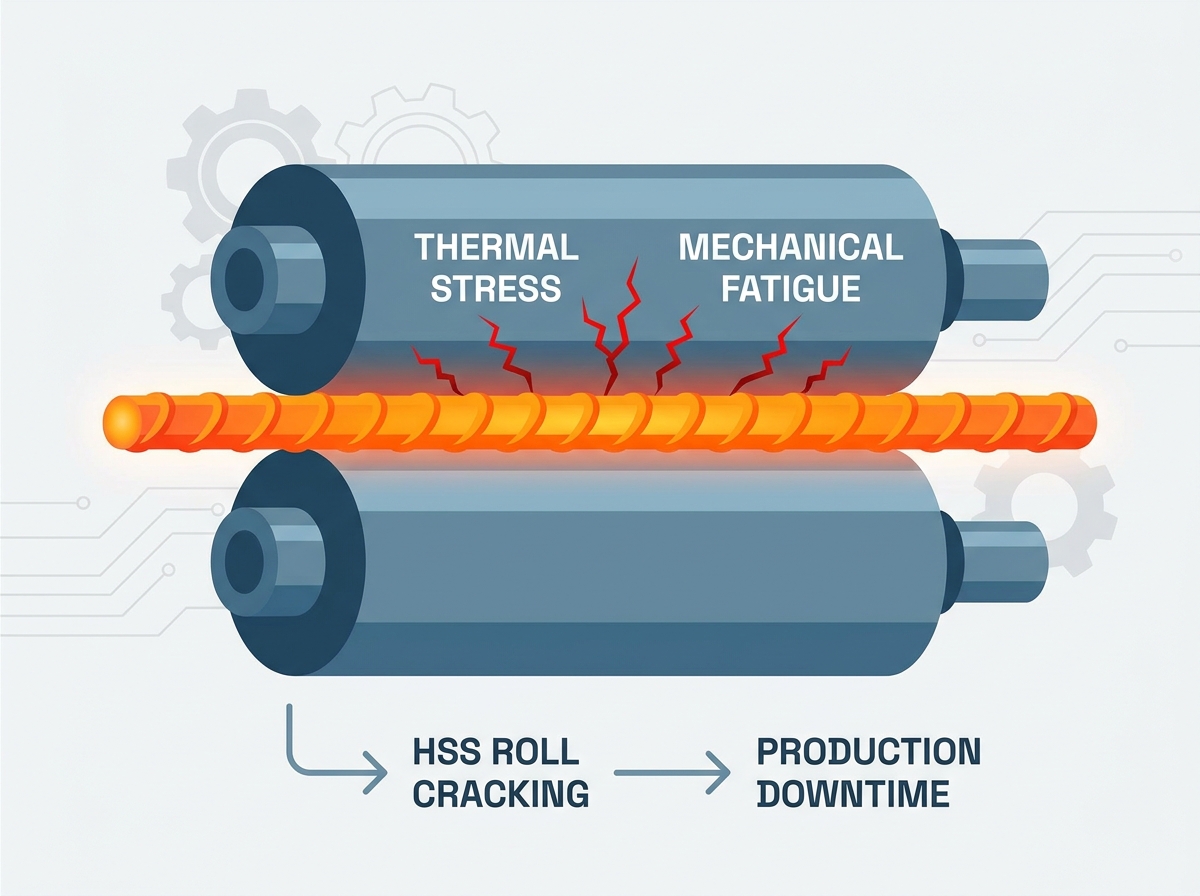
Thermal Fatigue combined with Frictional Shear is the Primary Catalyst: The alternating cycle of extreme heating in the roll bite and rapid water cooling initiates localized mesh-like thermal cracks (fire cracks), which are severely accelerated by frictional shear stress at the roll-gap interface.
Cooling Systems Dictate Roll Life: Inadequate, misaligned, or interrupted cooling water is the leading operational trigger for deep crack propagation, thermal-shock cracking, and catastrophic spalling.
Strict Grinding Protocols are Non-Negotiable: Failure to completely remove micro-cracks during routine maintenance guarantees fatigue crack propagation and early failure in subsequent rolling campaigns.
Damaged Rolls Damage the Product: A cracked or burnt roll pass directly transfers surface defects to the hot steel, leading to cracked rebar products and failed quality inspections.
Supplier Evaluation Matters: Mitigating failure requires evaluating roll manufacturers based on their heat treatment precision, residual stress management, and carbide network morphology.
Table of Contents
High-speed steel rolls endure extreme physical, mechanical, thermal, and tribological stresses in a rebar mill. Understanding the baseline criteria for identifying different crack types begins with analyzing the environment inside the roll bite. The material must withstand massive compressive forces, high-speed friction, and severe temperature fluctuations simultaneously. When these forces exceed the local fatigue limit of the steel matrix, surface degradation initiates. In a typical 18-stand continuous mill, the finishing stands subject the rolls to extreme rotational speeds and intense localized heat, creating a perfect storm for material fatigue.
The roll skin experiences aggressive alternating thermal expansion and contraction. As the roll contacts the hot billet, which often exceeds 1000°C, the surface temperature spikes rapidly, causing the outer layer to expand. Milliseconds later, the surface exits the bite and is blasted with high-pressure cooling water at roughly 30°C, forcing rapid contraction. This continuous cycle generates immense thermal fatigue. Surface micro-cracks, commonly known as fire cracks, naturally form under these conditions. They typically exhibit a shallow, mesh-like morphology, often penetrating 0.1mm to 0.5mm deep. While initial fire cracking is a normal wear mechanism, the propagation depth of these networks must be strictly monitored to prevent them from acting as initiation sites for deeper structural failures.
Friction between the hot bar and the roll pass generates intense surface shear stresses. The speed differential between the roll surface and the deforming steel creates a dragging effect in the backward slip zone and a pushing effect in the forward slip zone, amplifying the localized heat generated by plastic deformation. This frictional heat and shear stress significantly lower the material's local fatigue limit. The combination of thermal softening at the microscopic level and high shear forces accelerates the initiation of surface cracks, pulling the shallow fire cracks deeper into the roll matrix. The shear forces literally tear at the grain boundaries of the steel.
Heavy rolling loads, bending stresses, and localized impact forces act continuously upon existing thermal micro-cracks. As the roll rotates under load, these surface defects experience alternating tension and compression. This mechanical cycling transitions a stable surface thermal crack into an unstable sub-surface fatigue crack. Once a crack penetrates beyond the immediate thermally affected zone, mechanical stress becomes the primary driver of propagation, driving the fissure deeper toward the roll core. The separation force in the mill stand acts as a wedge, forcing the crack open with every revolution.
Spalling occurs when sub-surface cracks propagate parallel to the roll surface. Over time, these horizontal fissures join together, severing the structural integrity of the outer shell. Eventually, large chunks of the roll body break away dynamically during operation. Sudden spalling events pose immediate safety hazards to mill personnel, cause severe secondary equipment damage to guides and adjacent stands, and result in long-term financial risks due to scrapped rolls and extended mill downtime. The kinetic energy released during a spall can easily destroy entry and exit guide boxes.
Metallurgists and procurement teams must evaluate HSS roll specifications carefully to understand inherent material trade-offs. The very elements that give high-speed steel its exceptional performance characteristics also introduce specific vulnerabilities that must be managed through precise manufacturing and operational controls. The alloy design typically includes high percentages of carbon, chromium, molybdenum, tungsten, and vanadium.
There is a delicate balance between maintaining high wear resistance and retaining enough matrix toughness to resist impact loads and thermal shock. HSS relies on hard vanadium, tungsten, and chromium carbides to achieve its wear properties, often pushing the working layer hardness to 60-65 HRC. However, increasing the volume fraction of these hard phases inherently reduces the fracture toughness of the surrounding steel matrix. If the material is too hard, it becomes brittle and unable to absorb the kinetic energy of cobbles or the thermal shock of interrupted cooling. A roll that is too hard will simply shatter under abnormal mill conditions.
The morphology of the carbide structure dictates the roll's resistance to crack propagation. Continuous, coarse carbide networks at grain boundaries act as severe stress concentrators. They provide preferred, low-resistance paths for rapid crack propagation. Evaluating a supplier's manufacturing processes is critical. Methods like centrifugal casting must be tightly controlled to prevent carbide segregation, while powder metallurgy or continuous pouring processes for cladding (CPC) often yield superior results by ensuring fine, evenly distributed, and discontinuous carbide structures that arrest crack growth rather than accelerate it. MC and M2C type carbides must be finely dispersed.
Improper heat treatment during the quenching and tempering cycles leaves high residual tensile stresses in the roll core or surface. If a roll enters service with elevated internal stress, the threshold for operational cracking under standard rolling loads is drastically lowered. The combined operational stress and residual manufacturing stress can easily exceed the ultimate tensile strength of the material, leading to spontaneous deep cracking or catastrophic failure shortly after installation. Multiple tempering cycles are required to transform retained austenite into martensite and relieve these internal stresses.
Mill floor conditions, mechanical alignments, and operational errors frequently accelerate HSS roll cracking. Even perfectly manufactured rolls will fail prematurely if the rolling environment is poorly controlled. The transition from cast iron to HSS requires a complete overhaul of mill operating procedures.
Continuous, high-pressure, evenly distributed water cooling is a critical requirement to maintain a stable roll surface temperature. HSS retains heat longer than conventional iron. Blocked nozzles, insufficient water volume, or misaligned headers allow the roll surface to overheat. If cooling is delayed and then suddenly applied to a superheated roll, it induces massive thermal shock, resulting in severe quench-cracking that penetrates deep into the roll body. Water pressure must consistently hit 10 to 15 bar at the nozzle tip to break the steam barrier generated by the hot steel.
Cobbles or abnormal operating conditions where hot steel remains stationary in contact with the roll pass are devastating to HSS. The stationary hot bar acts as a massive heat sink, transferring extreme temperatures into a localized section of the stationary roll. This causes the immediate formation of severe, deep thermal cracks. The localized expansion and subsequent contraction when the cobble is cleared invariably compromise the structural integrity of that pass. Even a 10-second stall can generate enough localized heat to permanently damage the roll structure.
Rebar mills face specific challenges during splitting or slitting operations, particularly in the K3 stand. The high friction and thermal loads required to separate the steel strand place immense stress on the pass collar. "Burnt passes" frequently occur in the K3 stand when thermal overload exceeds the cooling capacity. This leads to deep cracks on the collar that transfer directly to the steel products, causing cracked, unsellable rebar and necessitating immediate roll changes. The dog-bone shape of the slitting pass concentrates stress at the apex of the slitting wedge, making it the most vulnerable point on the roll.
Excessive reduction ratios and heavy draft schedules concentrate mechanical stress and friction. Improper pass geometry forces the material to flow unnaturally, generating severe localized shear forces. When the draft schedule pushes the reduction beyond the optimal parameters for HSS, the resulting mechanical overload accelerates localized shear failure and fatigue cracking in the groove radii. Overfilling a pass forces the steel against the collar, generating lateral forces that the roll was not designed to withstand.
Implementing a robust diagnostic methodology allows roll shops to inspect rolls, identify crack types, and determine the root cause of an existing crack to prevent recurrence. Guesswork in the roll shop leads to repeated failures on the mill floor.
Visual and microscopic inspection can distinguish between different failure modes. Normal thermal fatigue presents as shallow, uniform fire-crack networks distributed evenly across the contact zone. Mechanical overload typically manifests as deep, linear cracks oriented perpendicular to the direction of maximum stress. Manufacturing defects often originate sub-surface, presenting dendritic crack paths that follow coarse carbide networks or casting anomalies. Roll shop technicians must be trained to read these crack patterns like a map of the mill's operating conditions.
Integrating NDT into the roll shop workflow is essential for verifying roll integrity before and after grinding. Relying solely on visual inspection is inadequate for high-speed steel.
NDT Method | Primary Application | Effectiveness for HSS Rolls |
|---|---|---|
Eddy Current Testing (ECT) | Surface crack detection and depth measurement. | Highly accurate for routine roll shop operations to ensure all thermal fatigue micro-cracks are removed during grinding. |
Ultrasonic Testing (UT) | Internal flaw and deep crack detection. | Critical for detecting deep internal cracks and sub-surface flaws before they reach the spalling threshold. |
Dye Penetrant Testing (PT) | Surface defect validation. | Serves as a quick, accessible, and low-cost validation method on critical roll passes and grooves during maintenance. |
Magnetic Particle Inspection (MPI) | Sub-surface crack detection near the roll skin. | Useful for identifying linear fatigue cracks that have propagated just below the visual surface layer. |
Mill managers must take actionable steps to protect their HSS roll investments and mitigate operational risks through disciplined maintenance. The roll shop is the first line of defense against catastrophic mill failures.
Baseline standards for water pressure, flow rate, and header nozzle design must be specifically tailored for HSS. The cooling needs of high-speed steel are vastly different from cast iron. Water must be applied at high pressure directly to the exit side of the roll bite to strip away the steam boundary layer and extract heat immediately, preventing thermal penetration into the roll core. Flat-jet nozzles positioned at a 15-degree angle against the direction of rotation provide the most effective heat extraction.
Grinding completely past the deepest micro-crack is an absolute necessity. The fatigue layer must be entirely removed to prevent crack propagation in the next campaign. Under-grinding to save roll diameter is a false economy; leaving microscopic fatigue cracks intact inevitably leads to catastrophic spalling and total roll loss. Mandatory NDT verification, utilizing ECT or PT post-grind, must be implemented to confirm the 100% elimination of surface cracks before the roll returns to service. Roll shops must use appropriate CBN (Cubic Boron Nitride) grinding wheels with specific feed rates to avoid inducing grinding cracks.
Following a mill stall or cobble, immediate and disciplined action is required to salvage the roll. Operators must follow a strict sequence of events to prevent further metallurgical damage.
Shut off cooling water to the affected stand immediately to prevent quenching the localized superheated zone, which causes severe quench-cracking.
Allow the roll to cool slowly in ambient air or under controlled thermal conditions to minimize thermal gradients.
Never resume rolling on that stand; remove the roll assembly immediately for thorough inspection.
Perform exhaustive NDT to locate the maximum depth of the damage and completely grind away the deep thermal damage zone before returning the roll to service.
Document the exact location and duration of the stall to update the roll history card for future tracking.
Conduct an immediate physical audit of all cooling headers on the finishing stands to verify nozzle alignment, water pressure, and flow rates.
Implement a mandatory Eddy Current Testing (ECT) sign-off sheet for every HSS roll leaving the grinding machine to guarantee zero residual micro-cracks.
Revise the standard operating procedure for mill stalls to mandate immediate water shutoff and automatic roll removal for the affected stand.
Schedule a joint review with your HSS roll supplier to analyze the carbide morphology and residual stress reports of the last three scrapped rolls.
Founded in 2007, Anhui Huanbowan High Speed Steel Mill Roll specializes in manufacturing high-speed steel rolls and roll rings for hot-rolled plate, strip, bar, wire, and other demanding rolling applications. With dedicated casting, heat-treatment, machining, quality-control, and technical R&D capabilities, the company supports steel mills in selecting reliable roll materials and improving roll performance under demanding production conditions.
A: The primary cause is the combined effect of severe thermal fatigue from alternating heating and cooling cycles, amplified by high frictional shear stresses and mechanical loads in the roll bite.
A: Prevention requires maintaining continuous, high-pressure, and evenly distributed water cooling to stabilize surface temperatures, alongside strict grinding protocols to remove early-stage micro-cracks before they propagate.
A: Fire cracks are shallow, mesh-like surface micro-cracks caused by normal thermal cycling. Spalling is a catastrophic failure where deep sub-surface fatigue cracks propagate parallel to the surface, causing large chunks of the roll to break away.
A: Leaving water on a stationary roll that is superheated by a stalled hot bar causes massive thermal shock. This rapid localized quenching induces severe, deep quench-cracks that destroy the roll's structural integrity.
A: The roll must be ground completely past the deepest point of the thermally damaged zone. This depth must be verified using Non-Destructive Testing (NDT) to ensure zero residual micro-cracks remain.
A: Surface cracks can be repaired by grinding them out entirely. However, if a crack has propagated deep into the roll core or if spalling has occurred, the roll cannot be safely repaired and must be scrapped.
A: K3 stand rolls endure extreme friction and thermal overload on the pass collar during splitting. This causes burnt passes and deep cracks, which directly transfer surface defects to the hot steel, resulting in cracked, rejected rebar.