Views: 0 Author: Site Editor Publish Time: 2026-07-27 Origin: Site
Precision in metal forming and sheet rolling dictates that mill components must withstand extreme mechanical stress without compromising dimensional accuracy. Roll deflection, uneven gauge thickness, and premature component failure—such as spalling, surface fatigue, or soft spots—lead to costly production halts, excessive scrap rates, and inflated maintenance budgets. Optimizing a rolling mill, whether a 2-high, 4-high, tandem, or cluster configuration, requires a precise understanding of the distinct functions, metallurgical requirements, and failure modes of both components. This guide breaks down the technical evaluation criteria for sourcing, comparing, and maintaining these heavy-duty industrial assets. We will examine the exact mechanical forces at play on the mill floor and how metallurgical choices directly impact your production uptime.
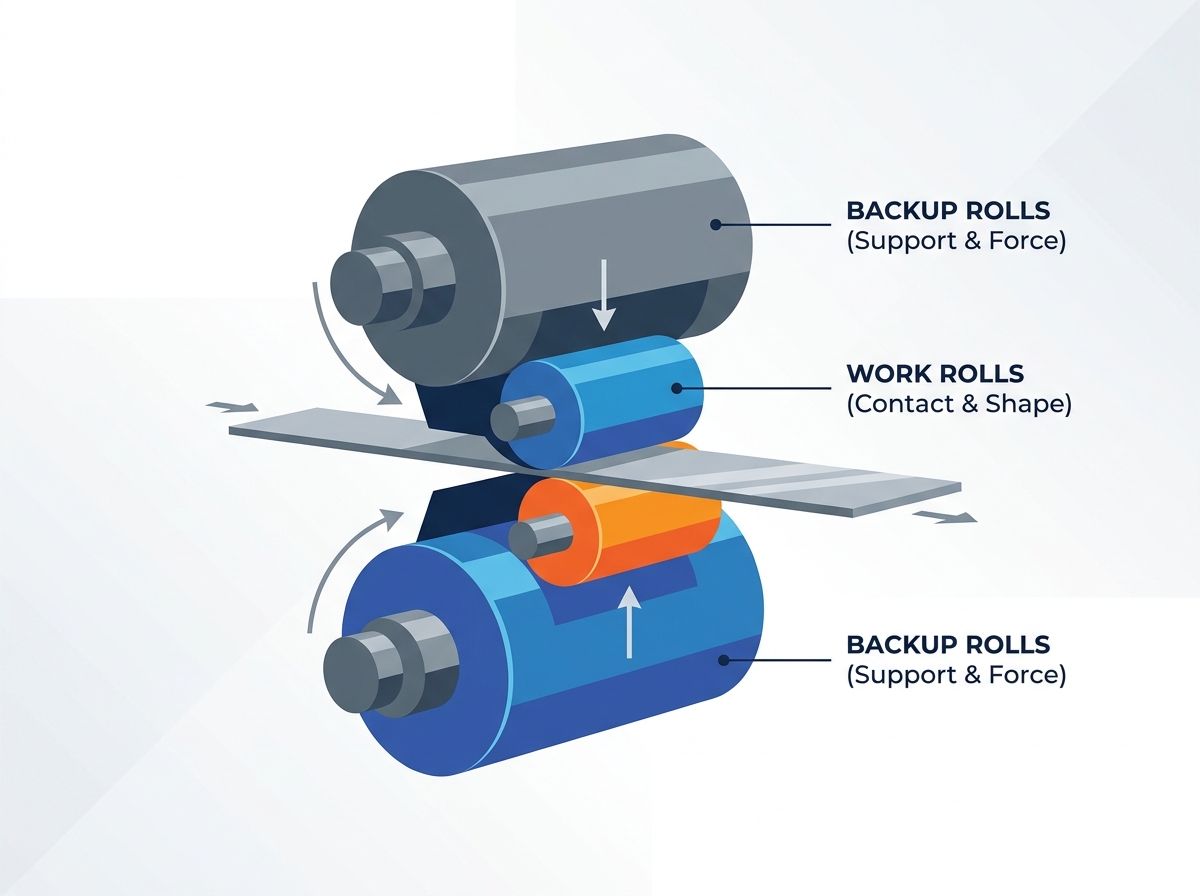
Distinct Mechanical Roles: The work roll makes direct contact with the metal strip to reduce thickness, while the larger backup roll provides essential rigid support to prevent the work roll from bending under high rolling forces.
Metallurgical Trade-offs: Work rolls require extreme surface hardness and wear resistance to maintain sheet finish; backup rolls require deep hardenability, high fatigue strength, and the elimination of secondary quenching to withstand continuous, heavy load distribution.
Failure Mechanisms Differ: Work rolls are highly susceptible to thermal shock and abrasive wear, whereas backup rolls primarily fail due to subsurface fatigue, work hardening from continuous contact pressure, and spalling.
Table of Contents
Achieving ultra-thin gauges and precise surface finishes is impossible if the rolling apparatus deflects under pressure. Understanding the mechanical dynamics when comparing a work roll vs backup roll is fundamental to mill design and daily operation. Mill operators know that even a fraction of a millimeter of deflection translates to rejected coils and wasted material.
The work roll acts as the primary deformation tool in direct contact with the metal strip. These rolls are typically smaller in diameter to reduce the roll bite area. A smaller bite area effectively lowers the required rolling force needed to achieve the target gauge reduction. The physical characteristics of this component directly dictate the surface finish, flatness, and final gauge of the processed material. Because they interface directly with the product, they must maintain strict dimensional tolerances throughout their operational cycle. Operators constantly monitor these components for surface degradation, as any flaw transfers directly onto the rolled sheet.
In practical mill environments, you will see these components swapped out frequently. Their smaller mass makes them easier to handle with overhead cranes, but their direct exposure to the abrasive metal strip means their surface degrades rapidly. The engineering challenge is maintaining a perfectly cylindrical shape while under immense compressive stress and thermal load.
Positioned above and below the primary deformation zone in multi-high configurations, the backup roll operates without touching the metal strip directly. These components are significantly larger in diameter and mass. Their primary job is to absorb and distribute the massive rolling forces measured by load cells. They act as the heavy artillery of the mill. They provide the necessary rigidity to prevent the smaller components from bowing or deflecting under extreme operational loads.
Without this massive structural support, achieving uniform thickness across a wide metal sheet would be physically impossible. The bending moment generated by the rolling force would cause the center of the sheet to be thicker than the edges, a defect known as crown. The massive diameter of the supporting component provides the high moment of inertia required to resist this bending.
Different rolling tasks require specific mill configurations to manage the forces involved. The layout of the mill dictates the exact specifications required for each component.
2-High Mills: Operating without supporting rolls, these setups are limited to thicker materials and lower-precision operations where deflection is less of a concern. They are common in primary breakdown mills.
4-High Mills: This standard configuration features two small primary rolls supported by two massive secondary rolls. This setup ensures high-precision, thin-sheet rolling capabilities and is the workhorse of modern steel and aluminum plants.
Cluster (Sendzimir) Mills: Multiple supporting rolls back up a single, highly specialized primary roll. This complex geometry allows the rolling of exceptionally hard materials, like stainless steel or titanium, down to ultra-thin foil gauges.
Tandem Mills: Sequential stands where the relationship between the components must be synchronized across multiple stages. This handles the cumulative strain hardening of the strip as it passes from stand to stand.
Selecting the right alloy and heat treatment based on the roll's specific function minimizes non-production time. The metallurgical demands for each roll type are vastly different due to their distinct operational environments. You cannot use the same steel grade for both components and expect the mill to function.
These components require high-carbon steel, forged steel, or high-speed steel (HSS) compositions. For instance, cold rolling applications often utilize 2% to 5% Chromium steel. These rolls must achieve extreme surface hardness, typically measured in Shore C or Leeb hardness scales. This hardness resists abrasive wear and maintains roughness retention over long production runs. Furthermore, they require high thermal conductivity and thermal shock resistance. This is especially critical in hot rolling applications to prevent fire cracking when the roll is subjected to rapid heating and cooling cycles.
The manufacturing process often involves complex heat treatments like induction hardening to create a deep, uniform hardened layer. This hardened shell must be tough enough to resist spalling but hard enough to impart the desired finish on the metal strip. The core remains relatively softer to absorb impact loads and prevent catastrophic brittle fracture.
These massive components are typically forged from medium-carbon alloy steels, such as Cr-Mo-V alloys. The metallurgical focus here shifts from pure surface hardness to deep hardenability and uniform hardness distribution. A critical manufacturing requirement is the elimination of secondary quenching. Rolls must be processed to avoid secondary quenching issues, ensuring zero soft spots and significantly reducing residual internal stresses.
A supporting roll requires a tough core to absorb shock loads and a highly fatigue-resistant outer shell to prevent subsurface crack propagation under massive continuous pressure. The forging process for these massive ingots requires immense hydraulic presses to consolidate the internal grain structure and eliminate porosity.
Technical Parameter | Primary Deformation Roll | Structural Support Roll |
|---|---|---|
Primary Function | Direct contact and deformation of the metal strip. | Structural support to prevent deflection. |
Size & Mass | Smaller diameter, lower mass. | Significantly larger diameter and massive weight. |
Metallurgy Focus | Extreme surface hardness, thermal shock resistance. | Deep hardenability, tough core, fatigue resistance. |
Alloy Types | High-carbon, HSS, 2-5% Cr steel. | Medium-carbon alloy, Cr-Mo-V. |
Primary Wear Mode | Abrasive wear, thermal fatigue (fire cracking). | Subsurface fatigue, work hardening, spalling. |
Misdiagnosing roll wear leads to catastrophic mill failure, roll breakage, and damaged product runs. Understanding how each roll degrades allows operators to implement effective preventative measures on the mill floor. You must train your maintenance crews to identify the early warning signs of these specific failure modes.
These components face aggressive environmental conditions at the roll bite. They suffer from abrasive wear caused by direct contact with the metal strip and surface scale. Thermal fatigue, commonly known as fire cracking, occurs due to the rapid heating and cooling cycles inherent in the rolling process. Over time, surface banding and roughness degradation develop. This directly compromises the final product's surface quality and dimensional accuracy.
Abrasive Wear: Continuous friction against the metal strip slowly grinds away the hardened surface layer.
Thermal Fatigue: Rapid temperature fluctuations cause micro-cracking on the surface, leading to a network of fine cracks known as fire cracking.
Surface Banding: Uneven wear patterns develop across the barrel length, transferring visible bands onto the rolled sheet.
Roughness Degradation: The specific surface texture required for proper lubrication and strip tracking wears smooth over time.
Supporting rolls degrade differently. The surface undergoes severe work hardening due to continuous, high-pressure contact with the primary roll under heavy load cell forces. This relentless pressure leads to subsurface fatigue, eventually resulting in spalling. Spalling is where large flakes of material break off from the roll body. Spalling remains the most critical and destructive failure mode for these massive components. Additionally, the development of soft spots due to improper manufacturing heat treatments or uneven load distribution can accelerate localized wear and compromise structural integrity.
Work Hardening: The continuous rolling contact pressure increases the surface hardness beyond its design limits, making it brittle.
Subsurface Fatigue: Micro-cracks initiate below the surface at the point of maximum shear stress.
Spalling: The subsurface cracks propagate and connect, causing massive chunks of steel to detach from the barrel.
Soft Spots: Localized areas of lower hardness wear faster, creating depressions that cause mill vibration and uneven rolling forces.
Evaluating manufacturers and specifying rolls for your facility requires strict adherence to technical parameters. Proper specification ensures the components can handle the specific mechanical demands of your rolling operation. You cannot rely on generic specifications; you must tailor the requirements to your specific mill stands.
Engineers must assess the required rolling force (tonnage) and match it precisely to the yield strength of the supporting component. The surface finish requirements must be specified based on the final product application. For example, rolling automotive exposed panels demands a vastly different roughness profile and hardness level compared to rolling standard structural steel. The crown profile must also be calculated to compensate for the specific thermal expansion and mechanical deflection expected during your typical product mix.
Rigorous testing protocols are non-negotiable when sourcing these heavy-duty components. You must demand comprehensive documentation from your suppliers.
Ultrasonic Testing (UT): Mandatory for detecting internal flaws, voids, or inclusions deep within the forged body.
Eddy Current Testing (ECT): Essential for identifying microscopic surface cracks that could propagate into larger failures.
Hardness Mapping: Verifying uniform hardness across the entire barrel length and circumference to ensure no soft spots exist.
Microstructure Analysis: Certified metallurgical reports confirming the correct grain size and the absence of undesirable phases like retained austenite.
The operational temperature fundamentally changes roll requirements. Cold rolling mills demand higher precision and different lubrication profiles, necessitating specific roughness retention capabilities. Conversely, hot rolling mills prioritize thermal fatigue resistance and oxidation management to survive the extreme heat of the incoming metal slab. The cooling water application in hot mills also introduces severe thermal shock, requiring alloys specifically designed to resist fire cracking.
Maximizing the operational lifespan of the rolls requires disciplined maintenance protocols and continuous monitoring. A reactive maintenance approach will inevitably lead to catastrophic failures and massive downtime.
Facilities must establish strict regrinding schedules based on tonnage rolled or operating hours. For supporting rolls, it is imperative to remove work-hardened layers before subsurface fatigue cracks propagate into catastrophic spalling. This requires removing a specific amount of material during each grind, regardless of visual appearance. Primary rolls often require cambering, or crowning, during the grinding process. This specific profiling compensates for thermal expansion and residual deflection under heavy operational loads, ensuring the final metal strip remains perfectly flat.
Modern rolling mills utilize real-time load cell data to monitor uneven rolling forces that accelerate fatigue. Implementing automated surface inspection systems allows operators to catch micro-cracking early. Vibration analysis on the mill stands can also detect the early stages of roll degradation or bearing wear. By integrating these data streams, maintenance teams can pull components from the mill just before they fail, maximizing their useful life while preventing unplanned downtime.
Selecting the right work roll and backup roll is essential for maintaining rolling accuracy, extending roll service life, and improving overall mill productivity. Matching the correct roll materials, heat treatment, and maintenance strategy to each mill application helps reduce downtime, minimize roll failures, and ensure consistent product quality.
About Anhui Huanbowan High Speed Steel Mill Roll
Anhui Huanbowan High Speed Steel Mill Roll is a professional manufacturer specializing in high-performance work rolls, backup rolls, and High Speed Steel mill rolls for hot strip mills, cold rolling mills, bar mills, and wire rod mills. By combining advanced forging and casting technologies, optimized heat treatment, and comprehensive quality inspection, the company delivers reliable roll solutions that help steel manufacturers improve rolling performance, extend campaign life, and reduce maintenance costs.
Select work rolls and backup rolls according to mill type, rolling force, and production requirements.
Monitor wear patterns, hardness distribution, and surface condition to optimize maintenance schedules.
Perform regular grinding, inspection, and predictive maintenance to maximize roll life.
Partner with experienced roll manufacturers that provide customized material solutions and technical support.
Before purchasing work rolls or backup rolls, verify the material composition, heat treatment process, hardness profile, quality inspection reports, and supplier expertise to achieve the best long-term rolling performance and operational reliability.
A: The primary roll directly contacts and deforms the metal strip to reduce its thickness. The larger supporting roll sits behind it to provide massive structural rigidity, preventing the smaller roll from bending under the extreme pressures required for metal deformation.
A: They require a significantly larger diameter and greater mass to absorb the immense rolling forces. This massive size provides the high moment of inertia necessary to keep the smaller primary roll perfectly straight, preventing sheet crown and ensuring uniform gauge.
A: Spalling is primarily caused by subsurface fatigue and severe work hardening. Continuous high-pressure contact creates maximum shear stress below the surface, initiating micro-cracks. These cracks eventually propagate and connect, causing large pieces of the steel shell to flake off.
A: Yes, 2-high rolling mills operate without them, but they are strictly limited to thicker materials and lower precision breakdown operations. For thin sheets and high-precision cold rolling, supporting rolls are mandatory to prevent deflection and maintain flat strip profiles.
A: Secondary quenching is an undesirable metallurgical occurrence during the manufacturing heat treatment process. It introduces high residual internal stresses and creates localized soft spots on the surface. Avoiding it ensures uniform hardness and superior anti-spalling performance during heavy mill operations.