Views: 0 Author: Site Editor Publish Time: 2026-07-27 Origin: Site
High-Speed Steel (HSS) has fundamentally shifted rolling mill economics by extending campaign lengths, but the geometric application of the material dictates its ultimate operational efficiency. Mill operators and metallurgical engineers must balance wear resistance, thermal stability, and maintenance downtime. Selecting the wrong tooling geometry leads to premature thermal cracking, excessive inventory costs, and prolonged changeover delays. This guide breaks down the structural and metallurgical differences of the roll vs roll ring. We provide a rigorous framework for specifying the correct tooling based on mill stand position, product type, and operational demands. Understanding these distinctions ensures you maximize mill uptime and product quality.
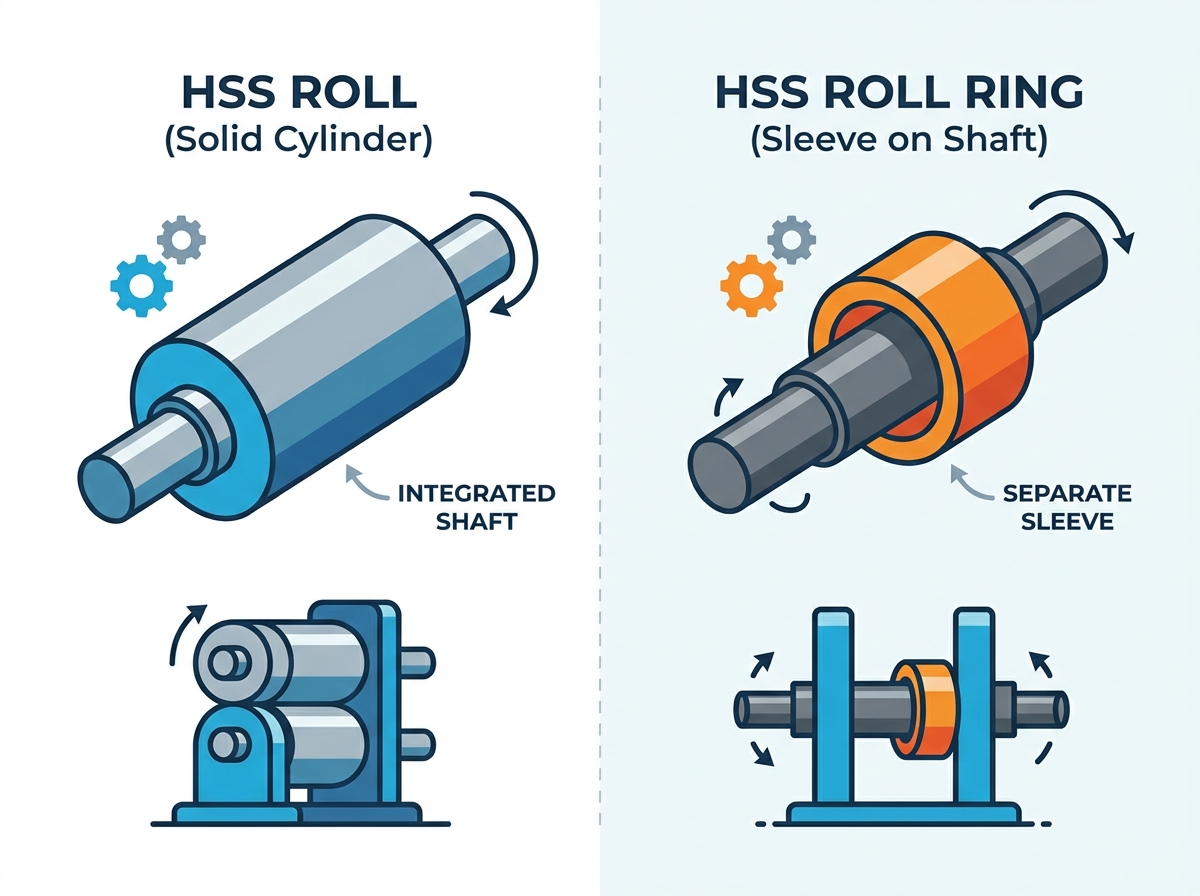
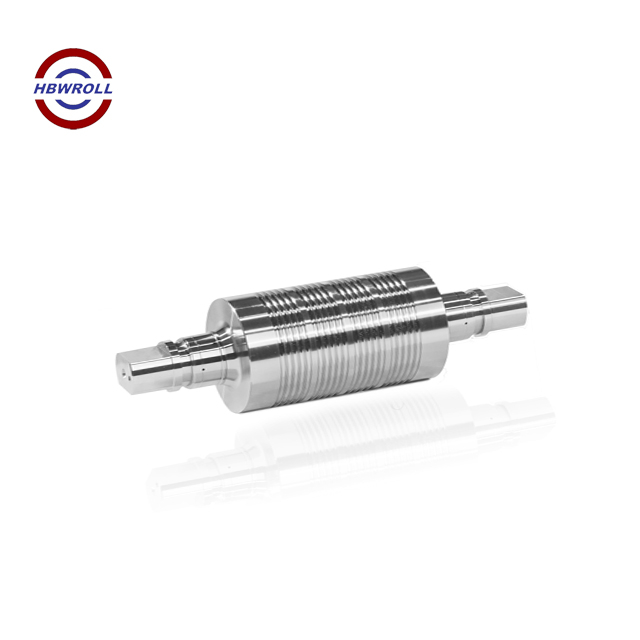
Structural Difference: An HSS roll is typically a monolithic or centrifugally cast composite cylinder with integral journals, whereas an HSS roll ring is a modular sleeve designed to be mounted onto a reusable arbor or shaft.
Application Specificity: HSS rolls are generally deployed as strip work rolls in roughing, intermediate, and early finishing stands; HSS roll rings dominate high-speed wire rod finishing blocks and sizing mills.
Maintenance Economics: Roll rings offer lower consumable replacement costs and reduced inventory footprints, but require precise hydraulic or mechanical mounting systems to prevent shaft slippage.
Metallurgical Trade-offs: Both utilize complex carbide matrices for high-temperature hardness, but roll rings often require stricter control over internal stresses due to their thinner cross-sections and mounting pressures.
Table of Contents
A complete HSS roll operates as a massive, self-contained cylindrical unit. It incorporates the working barrel, where the actual deformation of the steel occurs, and the integral necks or journals, which sit directly inside the mill stand bearings. Foundries manufacture these heavy-duty components using a vertical centrifugal casting process. During this operation, molten high-alloy tool steel is poured into a rapidly spinning mold. The centrifugal force pushes the dense, wear-resistant alloy to the outer perimeter, forming a shell typically 40mm to 80mm thick. Once the shell solidifies, operators pour a tougher, more ductile material—usually nodular cast iron or forged steel—into the center to form the core and the journals. This creates a metallurgical bond between the hard outer working layer and the shock-absorbing core.
Mill engineers specify these composite cylinders for heavy-reduction zones. You will find them installed in roughing stands, intermediate bar mills, and hot strip mills. The massive rolling forces generated in these early passes require absolute structural integrity. A solid, one-piece design prevents the catastrophic shear failures that modular components might suffer under extreme torque and separating forces. The integral journals allow the entire assembly to be swapped out as a single unit, complete with its chocks and bearings, using overhead mill cranes.
The physical mass of a composite cylinder also provides a significant thermal advantage. The large nodular iron core acts as a massive heat sink. As the working barrel contacts the 1000°C steel billet, the core absorbs and dissipates the thermal shock, preventing the brittle HSS shell from cracking under the sudden temperature gradient. This thermal mass is a primary reason why composite cylinders dominate the early stages of the rolling process.
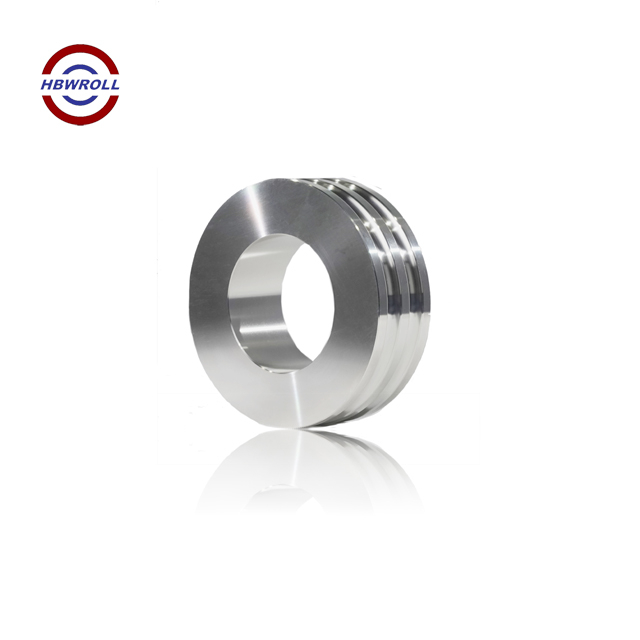
An HSS roll ring is a completely different geometric proposition. It is a modular, annular sleeve lacking any integral journals or mounting necks. Manufacturers produce these sleeves using static casting, centrifugal casting, or advanced powder metallurgy (PM) techniques. Unlike the composite cylinder, a sleeve features a uniform metallurgical structure throughout its entire cross-section. The goal is to achieve maximum hardness and wear resistance from the outer diameter all the way down to the inner bore.
These modular sleeves are engineered specifically for high-speed finishing blocks, such as Morgan V-blocks, wire rod mills, and sizing stands. In these final rolling stages, the steel profile is small, but the rolling speeds are extreme—often exceeding 100 meters per second. The separating forces are relatively low compared to roughing stands, making the massive structural integrity of a solid cylinder unnecessary. Instead, operators mount these sleeves onto reusable forged steel arbors or cantilevered shafts.
The modular nature of the sleeve allows for rapid tooling changes. When a pass wears out, maintenance crews do not need to remove massive bearing chocks. They simply depressurize the hydraulic mounting system, slide the worn sleeve off the arbor, and slide a new one on. This modularity drastically reduces the physical weight of the consumable tooling, making handling and storage much more efficient on the shop floor.
The performance of High-Speed Steel relies entirely on its complex alloy chemistry. Metallurgists design the matrix with high concentrations of strong carbide-forming elements, specifically tungsten (W), molybdenum (Mo), chromium (Cr), vanadium (V), and sometimes cobalt (Co). When combined with a carefully controlled carbon content (typically between 1.5% and 2.5%), these elements precipitate into extremely hard alloy carbides during solidification and subsequent heat treatment.
Vanadium forms MC-type carbides, which are the hardest particles in the matrix, providing exceptional resistance to abrasive wear from mill scale. Molybdenum and tungsten form M2C and M6C carbides, which enhance high-temperature strength and prevent the matrix from softening during hot rolling. Chromium forms M7C3 carbides, contributing to both wear resistance and the formation of a protective oxide film on the barrel surface. This specific combination of carbides allows HSS to vastly outperform conventional high-chrome iron or indefinite chill materials.
Achieving the final mechanical properties requires a rigorous, multi-stage heat treatment protocol. Both composite cylinders and modular sleeves undergo similar thermal processing to unlock their full potential. The process involves several distinct phases:
Austenitizing: The components are heated to extremely high temperatures (often exceeding 1050°C) to dissolve the alloy elements into the austenite matrix.
Quenching: Rapid cooling forces the austenite to transform into hard, brittle martensite while trapping the alloy elements in a supersaturated solid solution.
First Tempering: The components are reheated to around 500°C–550°C. This relieves quenching stresses and triggers the precipitation of secondary alloy carbides.
Subsequent Tempering Cycles: Two or three additional tempering cycles ensure that any retained austenite fully transforms into martensite, maximizing dimensional stability and final hardness.
This secondary hardening phenomenon is what gives HSS its incredible wear resistance. The working layer maintains a dense, uniform dispersion of microscopic carbides supported by a tough tempered martensite matrix. This structure resists the gouging and abrasive action of the incoming steel profile far better than standard roll materials.
Rolling mill environments subject tooling to severe thermal punishment. The surface of the tooling regularly contacts steel heated to between 800°C and 1050°C. Conventional materials experience a rapid drop in yield strength at these temperatures, leading to plastic deformation, pass wear, and loss of product tolerance. HSS exhibits exceptional dynamic hot hardness. The complex carbides and the highly alloyed matrix remain stable even when surface temperatures spike during the rolling bite.
This thermal stability prevents the pass profile from washing out or deforming under load. Operators can maintain tight dimensional tolerances on the rolled product for significantly longer periods. The tooling resists the softening effect that typically forces premature changeovers in standard iron setups.
While HSS excels in hot hardness, it is notoriously sensitive to thermal shock. The rapid heating during the rolling bite followed immediately by intense water cooling creates massive alternating thermal stresses on the surface. Over time, this thermal cycling initiates microscopic heat checks or fire cracks.
The geometry of the tooling dictates how it handles this thermal fatigue. A composite cylinder utilizes its massive ductile core to absorb the thermal expansion of the brittle outer shell. The core restricts the propagation of surface cracks, preventing them from driving deep into the barrel. A modular sleeve lacks this internal heat sink. It relies entirely on the mounting arbor and the external cooling headers to manage thermal expansion. If a cooling nozzle clogs or water pressure drops, the sleeve will rapidly overheat, expand, and potentially fracture due to the hoop stress generated against the rigid steel arbor.
Transitioning from standard cast iron to HSS tooling completely rewrites the baseline expectations for campaign lengths. The initial wear rate of HSS is exceptionally low. During the first few hours of a campaign, conventional iron tooling loses its precise pass geometry quickly as the softer matrix wears away. HSS maintains its exact machined profile for a much longer duration.
This extended wear life directly impacts mill productivity. Operators experience fewer interruptions for pass changes. The dimensional consistency of the rolled product remains stable, reducing the amount of out-of-tolerance scrap generated during a shift. In many bar and rod mills, upgrading to HSS can increase the tonnage rolled per pass by a factor of three to five compared to indefinite chill iron.
The metallurgical properties of HSS directly influence the surface finish of the final rolled product. At high rolling temperatures, the chromium content in the HSS matrix promotes the formation of a thin, tenacious, and self-renewing oxide film on the working surface. This oxide layer acts as a solid lubricant, preventing the hot steel from micro-welding to the tooling.
This anti-galling characteristic eliminates surface defects like banding, peeling, or scabs on the finished wire, rod, or strip. However, operators must remain vigilant regarding roll marks. Because HSS is so hard, any foreign debris, cold steel fragments, or cobbles that pass through the stand will not embed into the tooling. Instead, they will dent or chip the brittle surface, leaving a permanent defect that will imprint onto every subsequent meter of rolled steel until the tooling is changed.
The friction coefficient of HSS differs significantly from both traditional iron and tungsten carbide. HSS generally exhibits a lower coefficient of friction than rough cast iron, which can affect the bite angle in early roughing stands. If the surface is too smooth, the stand may refuse to bite the incoming billet, causing a cobble.
To counteract this, roll shops often apply specific surface texturing or shot blasting to HSS cylinders used in roughing applications. In finishing stands, however, the lower friction coefficient is highly desirable. It reduces the amount of heat generated by sliding friction in the pass and helps maintain precise tension control between stands without scratching the surface of the high-speed wire rod.
Performance Metric | Conventional Cast Iron | High-Speed Steel (HSS) | Tungsten Carbide (TC) |
|---|---|---|---|
Wear Resistance | Low | High | Very High |
Thermal Shock Resistance | High | Moderate | Low |
Friction Coefficient | High | Moderate | Low |
Typical Application Zone | Roughing / Intermediate | Intermediate / Finishing | High-Speed Finishing Blocks |
The physical geometry of the tooling dictates the maintenance workflow on the shop floor. Replacing a composite cylinder is a heavy rigging operation. Maintenance crews must disconnect the cooling headers, unbolt the chock restraints, and use an overhead crane to lift the entire assembly out of the mill housing. They then transport the heavy unit to the roll shop, where mechanics strip the bearings and chocks before the cylinder can be ground. This process requires significant manpower and crane availability.
Swapping a modular sleeve on a finishing block is a completely different procedure. The arbor remains installed in the mill stand. Mechanics use specialized hydraulic pumps to pressurize the mounting nut, expanding the sleeve slightly to break the interference fit. They slide the worn sleeve off by hand or with a light jib crane, clean the arbor, slide a new sleeve on, and release the hydraulic pressure to lock it in place. This modular approach drastically reduces the physical labor and time required for a changeover.
The modularity of the sleeve introduces complex engineering requirements for mounting. A solid cylinder simply rests its integral journals inside heavy-duty bearings. A sleeve must be rigidly fixed to a rotating arbor to transmit the rolling torque without slipping. Facilities utilize several methods to achieve this, including hydraulic nuts, tolerance rings, or mechanical clamping systems.
The most critical factor in sleeve mounting is managing the coefficient of thermal expansion. HSS expands at a different rate than the forged steel arbor. As the assembly heats up during rolling, the sleeve expands outward. If the initial mounting interference is too loose, the sleeve will lose its grip on the arbor, spin freely, and destroy the shaft. If the initial interference is too tight, the combined stress of the hydraulic mounting pressure and the thermal expansion will exceed the tensile strength of the HSS, causing the sleeve to shatter explosively mid-campaign. Engineers must calculate and enforce strict mounting tolerances to prevent these failures.
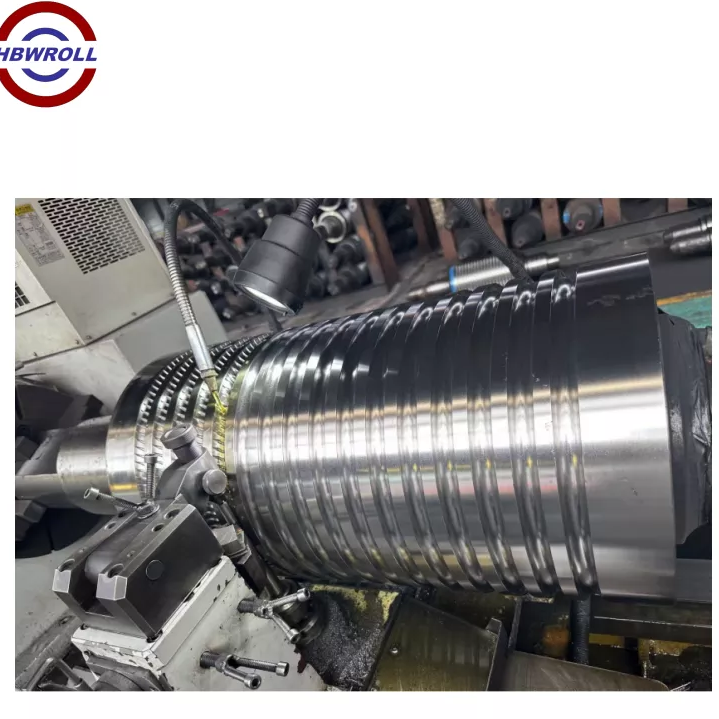
Machining HSS requires specialized equipment and abrasives. Standard aluminum oxide grinding wheels cannot cut the hard vanadium and molybdenum carbides present in the matrix. Roll shops must invest in Cubic Boron Nitride (CBN) or diamond grinding wheels to redress HSS tooling effectively. The grinding machines must possess high dynamic stiffness to prevent chatter, which can induce micro-cracks in the brittle HSS surface.
The redressing lifecycle varies based on the geometry. For a composite cylinder, the roll shop grinds the barrel down repeatedly until they exhaust the 40mm to 80mm working layer and reach the softer core material. For a modular sleeve, the shop grinds the individual passes deeper into the ring until the remaining wall thickness reaches the minimum safe scrap diameter specified by the manufacturer. Once a sleeve reaches this scrap diameter, it cannot be salvaged and must be discarded.
HSS is exceptionally sensitive to thermal shock and localized overheating. Inadequate cooling is the leading cause of premature failure. If the water pressure drops, or if a nozzle clogs, the surface temperature of the tooling will spike rapidly. When the water flow resumes, the sudden quenching effect will initiate deep thermal cracks that quickly propagate into massive spalls.
You must mandate specific water pressure, volume, and nozzle alignment audits before transitioning to this material. Consistent, high-pressure water delivery is non-negotiable. Cooling headers must be designed to wrap around the tooling, delivering high-velocity water directly to the exit side of the rolling bite to strip away the heat before it penetrates the matrix. Implement automated flow meters and pressure sensors to shut down the mill instantly if cooling water is interrupted.
Over-pressurization during hydraulic mounting causes fractures before the tooling even touches the steel. Mechanics often over-tighten hydraulic nuts to ensure the sleeve does not slip, inadvertently pushing the internal hoop stress past the yield point of the brittle HSS material. Thermal expansion mismatches exacerbate this risk once rolling commences.
Implement strict torque and pressure guidelines for all assembly procedures. Calibrate hydraulic pumps regularly. Utilize stress-relieving chamfers on the edges of the sleeves to prevent stress concentrations. Ensure precise machining tolerances on the mounting arbor; any high spots or out-of-roundness on the shaft will create localized pressure points that will crack the sleeve.
Older mill stands often lack the structural rigidity required to handle the higher rolling forces sometimes associated with HSS profiles. Because HSS does not yield or wear quickly, it transfers more of the rolling force directly into the mill housing. The material does not give; the mill stand will.
Conduct a thorough structural audit of chocks, bearings, and housings prior to adoption. Look for excessive wear in the housing windows or degraded bearing fits. Upgrade bearing capacities if necessary. Ensure that the hydraulic screw-down mechanisms can handle the sustained loads without drifting, as any mill stretch will negate the dimensional accuracy benefits provided by the HSS tooling.
Choosing between an HSS Roll and an HSS Roll Ring depends on your mill configuration, rolling process, maintenance strategy, and production goals. Selecting the appropriate High Speed Steel tooling for each mill stand helps maximize wear resistance, improve product quality, reduce downtime, and achieve longer rolling campaigns.
About Anhui Huanbowan High Speed Steel Mill Roll
Anhui Huanbowan High Speed Steel Mill Roll is a professional manufacturer specializing in High Speed Steel mill rolls and roll rings for hot strip mills, bar mills, section mills, and wire rod mills. Through advanced alloy development, precision casting, optimized heat treatment, and strict quality control, the company provides durable rolling solutions that help steel producers improve production efficiency, extend tooling life, and reduce maintenance costs.
Choose HSS Rolls or HSS Roll Rings according to mill stand position, rolling speed, and maintenance requirements.
Ensure proper cooling, mounting, and grinding procedures to maximize tooling performance.
Evaluate tooling based on wear resistance, thermal stability, and lifecycle cost instead of purchase price alone.
Work with experienced manufacturers that provide customized metallurgical solutions and technical support.
Before selecting an HSS Roll or Roll Ring, verify the tooling design, alloy composition, cooling requirements, mounting system compatibility, and supplier expertise to achieve the best long-term rolling performance.
A: A roll is a complete cylindrical unit with integral journals for mounting directly into bearings. A roll ring is a modular sleeve that lacks journals and must be mounted onto a separate, reusable shaft or arbor.
A: Yes. HSS rings are increasingly used as alternatives to tungsten carbide. They offer better resistance to thermal shock and carry a lower risk of catastrophic failure, although they possess slightly lower absolute wear resistance.
A: The highly dispersed, hard alloy carbide phase and the secondary-hardened martensitic matrix resist abrasive wear from the incoming billet or strip far better than standard iron or steel from the very start of the campaign.
A: Proper mounting requires hydraulic nuts or mechanical clamping systems. You must precisely match the thermal expansion coefficients of the ring and the arbor while adhering to strict torque guidelines to prevent slippage or bursting.
A: Yes. Due to the extreme hardness of the alloy carbides in the matrix, redressing HSS requires specialized CBN (Cubic Boron Nitride) or diamond grinding wheels mounted on high-stiffness grinding machines.