Views: 0 Author: Site Editor Publish Time: 2026-07-27 Origin: Site
Industrial rolling profitability relies heavily on maximizing tonnage per roll campaign while strictly minimizing unplanned mill downtime. Premature groove degradation, unpredictable thermal fatigue, and catastrophic roll failures routinely disrupt production schedules. These issues inflate tooling costs and severely degrade the final product surface quality. Mill operators constantly face the daily challenge of maintaining groove integrity under extreme mechanical and thermal loads. You cannot simply throw harder materials at the problem and expect better results.
Specifying the correct roll metallurgy requires moving past the outdated assumption that harder always equals better. Understanding the precise relationship between roll hardness and wear resistance is critical for optimizing groove life. It allows you to establish accurate predictive maintenance schedules and select the exact roll specifications needed for specific mill stands. We must evaluate the mechanics of groove wear, material selection trade-offs, and practical monitoring strategies to keep mills running efficiently.
Hardness Does Not Equal Invulnerability: While high hardness improves baseline abrasion resistance, it often sacrifices the toughness required to withstand mechanical impact and thermal shock.
Wear is a Multiplex Process: Groove life is dictated by a complex combination of mechanical abrasion, adhesive wear, thermal fatigue, tribo-corrosion, and roll geometry.
Depth of Hardness Matters: Surface hardness measurements alone are insufficient; the hardness gradient from the working surface to the core determines the roll's usable lifespan and regrind potential.
Data-Driven Specification: Selecting the optimal roll requires balancing target tonnage against regrind costs, cooling capabilities, and historical failure modes (e.g., spalling vs. uniform wear).
Table of Contents
Hardness is a material's resistance to localized plastic deformation, such as indentation or scratching. In a rolling mill environment, high hardness protects the roll surface from the immediate abrasive action of the metal stock and heavy oxide scales. Toughness, conversely, is the material's ability to absorb energy and deform plastically before fracturing. It prevents catastrophic failures when the roll encounters sudden impacts, cold stock ends, or extreme stress concentrations during a cobble.
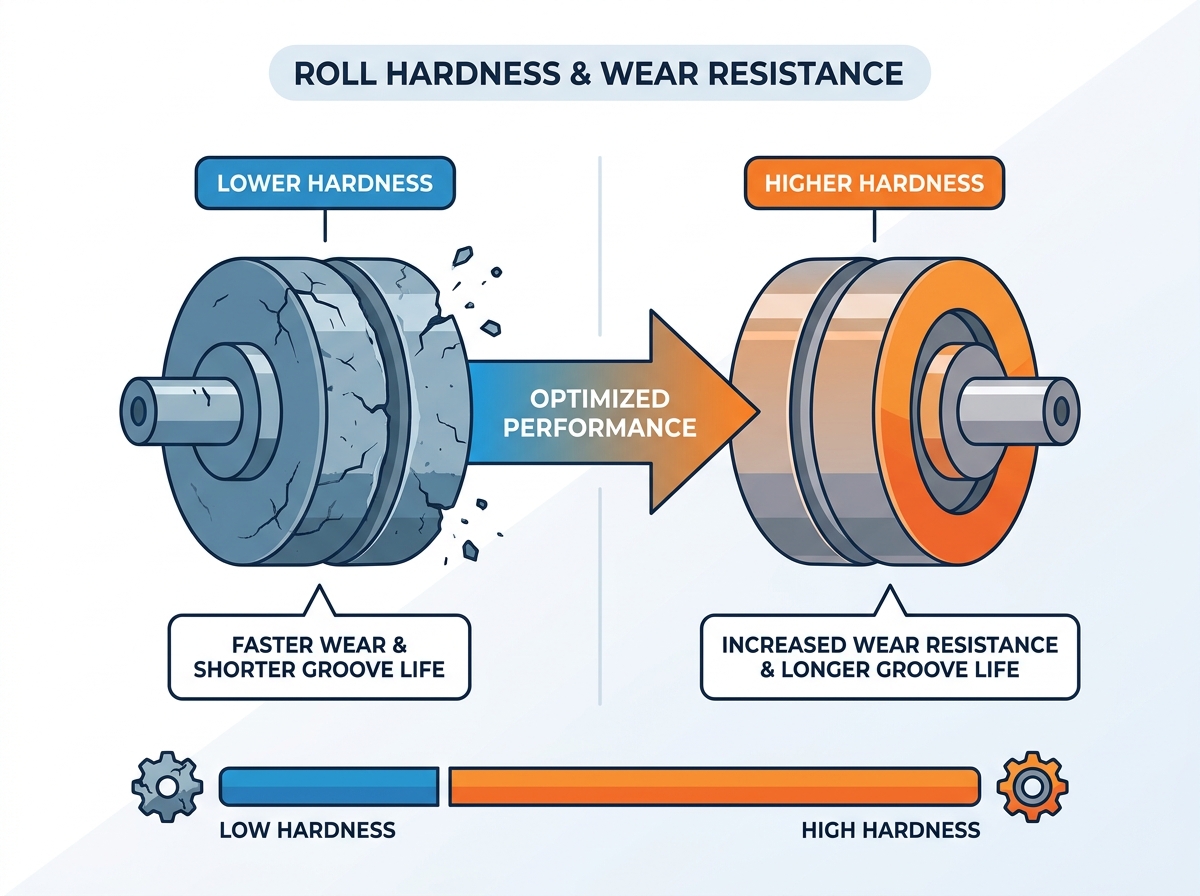
These two properties share a strict inverse relationship. As roll hardness increases to combat abrasion, fracture toughness typically decreases. This makes the roll significantly more vulnerable to cracking under heavy reduction loads or sudden temperature shifts. Balancing these properties ensures the roll can withstand continuous friction without shattering under pressure. You need enough hardness to hold the groove profile, but enough toughness to survive the mill dynamics.
A common misconception on the mill floor is that specifying the highest available hardness guarantees the longest roll life. Over-hardened rolls introduce severe operational risks. They exhibit increased brittleness, making them highly susceptible to catastrophic spalling. A brittle roll offers a heavily reduced tolerance for mill cobbles, folded stock, or operational anomalies. What should be a minor delay turns into a destroyed roll and a lengthy stand change.
Effective wear resistance requires a balance of hardness, microstructure, and thermal stability tailored to the specific rolling environment. A material can be highly wear-resistant and tough without possessing extreme macroscopic hardness. Specialized alloy matrices resist deformation through work-hardening behavior during service. The distribution of primary and secondary carbides within the microstructure often plays a much larger role in preventing wear than the overall bulk hardness of the roll.
Severe rolling and reduction steps cause rapid work-hardening and strength increases in the rolled stock. Materials like brass, copper, high-carbon steel, and complex alloys become significantly harder as they pass through successive stands. This hardening of the rolled material mid-pass feeds back directly into the roll surface. The roll is no longer biting into soft, yielding metal.
As the stock hardens, it escalates the mechanical stress and abrasive forces acting on the roll groove. The roll must overcome this dynamically increasing resistance pass after pass. Therefore, roll hardness and wear resistance must be specified not just for the initial state of the billet, but to withstand the hardened state of the workpiece in the later finishing passes. If you specify finishing rolls based on roughing stand parameters, the grooves will wash out rapidly.
Hard oxide scales form rapidly on the rolled stock and act as aggressive cutting agents. These scales scour the roll groove, leading to severe abrasive wear. Adequate roll hardness directly mitigates this mechanism by preventing the scale from gouging the surface matrix. Adhesive wear occurs through micro-welding between the roll surface and the hot stock. As the materials separate under high pressure, material transfers or tears from the roll surface, leaving a pitted finish.
Velocity mismatches within deep grooves create sliding friction rather than pure rolling friction. This sliding accelerates localized material loss at the flanges. Intense frictional sliding under heavy loads generates high shear stresses at the interface. This leads to subsurface plastic deformation and subsequent sheet-like material detachment, known in the field as delamination. You will see this as a rough, flaky texture inside the groove.
Rolls experience extreme temperature fluctuations during the heating cycle of contacting the hot stock and the aggressive cooling cycle from high-pressure water sprays. These rapid thermal cycles generate alternating compressive and tensile stresses within the roll surface. Over time, these stresses lead to networks of thermal cracks, commonly referred to as fire cracks. Every roll develops them; the goal is managing their depth.
Excessive roll hardness can accelerate the propagation of these thermal cracks. Harder, more brittle materials possess lower crack-tip bluntness. Instead of arresting the crack near the surface, the brittle microstructure allows it to propagate into deep structural flaws. If water penetrates these deep cracks during rolling, the resulting steam expansion will blow chunks of the roll face off.
Tribo-corrosion is the accelerated degradation of the roll material resulting from the simultaneous action of mechanical wear and chemical attack. Cooling water, scale inhibitors, and high-temperature oxidation constantly interact with the roll surface. Mechanical wear continuously removes protective passive oxide films from the roll, exposing raw material.
This removal exposes fresh, highly reactive metal to corrosive cooling media. Optimizing alloy chemistry and surface properties is required to mitigate tribo-corrosive attack. Simply increasing macroscopic hardness does not stop chemical degradation. The material must possess inherent corrosion resistance, often achieved through chromium or nickel additions, to survive the wet, aggressive mill environment.
Roll geometry directly dictates contact pressure distribution and metal flow. Groove depth, flange angles, pass design, and roll diameter all influence how the stock interacts with the roll. The geometry of deep groove profiles creates varying peripheral speeds along the contact line. The metal flows at different rates depending on where it sits in the pass.
The speed at the pitch line differs significantly from the speed at the flange or groove bottom. This mismatch creates localized sliding zones with heightened shear and adhesive wear. Strategic profile design minimizes these localized velocity deltas and optimizes the wear profile across the working roll surface. Good pass design extends roll life just as much as good metallurgy.
Spalling is a subsurface fatigue failure where large flakes of roll material detach from the main body. High contact stresses, impact from cold stock ends, and the propagation of un-removed thermal cracks during rolling cause spalling. The toughness-to-hardness ratio dictates a roll's resistance to this failure mode.
A roll that is too hard will lack the fracture toughness needed to absorb impact energy. When a cold end hits a brittle roll, it results in deep spalls that require extensive regrinding. Sometimes the spall is so deep the roll must be scrapped entirely. You must match the roll's impact resistance to the specific stand's historical cobble and cold-end frequency.
Nodular or ductile cast iron rolls are frequently evaluated for roughing stands. The graphite within the iron matrix provides excellent thermal shock resistance and natural lubrication. This balances moderate hardness with high toughness, making it ideal for the heavy reductions and impacts of early passes. You want a roll that will dent rather than shatter when a cold billet hits it.
Forged steel rolls are typically evaluated for finishing stands. They achieve high, uniform hardness profiles necessary for superior surface finish on the final product. However, forged steel requires strict thermal management to prevent fire cracking. If your water headers are clogged or misaligned, a forged steel roll will fire-crack and spall very quickly.
Material Type | Primary Application | Hardness Level (Shore C) | Toughness / Impact Resistance | Key Operational Advantage |
|---|---|---|---|---|
Nodular Cast Iron | Roughing Stands | 50 - 65 | High | Excellent thermal shock resistance and bite |
Indefinite Chill Iron | Intermediate Stands | 65 - 75 | Moderate | Good balance of wear and fire crack resistance |
Forged Steel | Finishing Stands | 75 - 85 | Moderate to Low | Uniform surface finish and high density |
High-Speed Steel (HSS) | Early Finishing / Wire Rod | 80 - 90+ | Low | Extreme high-temperature wear resistance |
High-Speed Steel (HSS) utilizes complex carbides formed from tungsten, molybdenum, and vanadium to achieve exceptional high-temperature hardness and wear resistance. HSS maintains its integrity even when the roll surface temperature spikes during long rolling campaigns. However, HSS rolls require stringent cooling requirements. If the water cooling is inadequate, the surface will degrade rapidly.
Tungsten carbide rings are used extensively in high-speed wire rod blocks. They offer extreme hardness and wear resistance, allowing for massive tonnage between changes. However, they suffer from extreme brittleness. They require specialized mounting requirements, usually on a steel arbor, to prevent shattering under rolling loads. You cannot treat a carbide ring like a standard cast roll.
Advanced surface treatments apply a highly wear-resistant, hard barrier onto a tough, shock-resistant substrate. Techniques include laser cladding, thermal spraying, nitriding, and hard thin-film coatings. These methods are gaining traction for specific mill applications where bulk material properties force too many compromises.
Engineered surface coatings prevent adhesion, corrosion, and severe sliding wear. They allow operators to decouple surface properties from bulk properties. You get the hard, slick surface needed for product quality without requiring the entire bulk roll to be brittle or over-hardened. This is particularly useful in specialized flat rolling or sizing stands.
The hardness gradient—the drop-off in hardness from the surface to the core—is a critical specification. Surface hardness measurements alone are completely insufficient for evaluating a roll. Manufacturing techniques like differential heat treatment and centrifugal casting achieve a hard, wear-resistant shell over a tough, shock-absorbing core.
The depth of hardness dictates the number of viable regrinds. A shallow hardness depth means the roll will quickly lose its wear resistance after a few maintenance grinds. Once you grind past the hard shell, the soft core will wash out immediately in the mill, drastically reducing the total lifecycle value of the roll. Always verify the hardness depth curve before purchasing.
Field measurement of roll hardness relies heavily on portable testing methods. The Leeb Rebound Method is the industry standard for large rolls on the shop floor. An impact body is launched towards the roll surface, and the hardness value is calculated via the changes in the speed of the impact body before and after the bounce. It is fast, repeatable, and leaves minimal surface marking.
This method allows maintenance teams to map the hardness profile of the roll across different groove depths. You must ensure the material remains within specification after regrinding and before returning to the mill stand. Proper surface preparation is mandatory; testing on a rough, unground surface will yield falsely low readings. Always calibrate your testing devices against standard blocks before mapping a roll.
Consistent monitoring allows you to track how roll hardness and wear resistance degrade over the roll's lifespan. By logging this data against rolled tonnage, you can predict exactly when a roll will reach its minimum hardness threshold. This prevents operators from putting a soft roll back into a finishing stand, which would result in immediate groove failure and rejected product.
Optimizing roll hardness and wear resistance requires balancing hardness, toughness, metallurgy, and operating conditions rather than simply selecting the hardest available roll material. Choosing the right roll specification and implementing effective monitoring strategies can significantly extend groove life, reduce downtime, and improve rolling mill productivity.
About Anhui Huanbowan High Speed Steel Mill Roll
Anhui Huanbowan High Speed Steel Mill Roll is a professional manufacturer specializing in high-performance mill rolls for hot strip mills, section mills, bar mills, and wire rod mills. Leveraging advanced casting technology, optimized alloy design, precise heat treatment, and comprehensive quality inspection, the company delivers durable, high-wear-resistant mill rolls that help steel manufacturers improve productivity, extend roll service life, and reduce operating costs.
Select roll materials based on mill stand position and operating conditions rather than hardness alone.
Monitor groove wear and hardness changes regularly to establish predictive maintenance schedules.
Evaluate hardness depth, thermal fatigue resistance, and toughness together when selecting mill rolls.
Work with experienced manufacturers that provide technical support and customized roll solutions for different rolling applications.
Before selecting a High Speed Steel Mill Roll, verify the roll metallurgy, hardness profile, wear resistance, manufacturing quality, and supplier expertise to maximize rolling performance and long-term value.
A: Higher hardness often reduces fracture toughness. If the roll is too brittle, it cannot absorb mechanical impacts or thermal shocks, leading to deep cracking or catastrophic spalling instead of gradual, predictable wear.
A: As metal passes through successive stands, it work-hardens. This increases the mechanical resistance and abrasive friction against the roll groove, accelerating wear, especially in later finishing passes.
A: Abrasive wear occurs when hard oxide scales cut into the roll surface. Adhesive wear happens when the hot stock micro-welds to the roll, tearing away small particles of the roll material as the surfaces separate.
A: The hardness gradient determines how deep the wear-resistant layer goes. A steep drop-off means the roll will become soft and unusable after only one or two regrinds, drastically shortening its total lifespan.
A: Deep grooves create different peripheral speeds along the contact area. This velocity mismatch causes sliding friction rather than pure rolling, which increases shear stress and accelerates localized material loss.
A: Tribo-corrosion is the combined effect of mechanical wear scraping away protective surface layers and chemical attack from cooling water and oxidation, leading to rapid degradation of the roll material.